Best Time to Go to Portugal: Lisbon vs Porto Weather by Month
The best time to go to Portugal is June or September: Lisbon averages 75.9°F to 77.9°F (24.4°C to 25.5°C) with 3 to 4 rainy days. Porto gets about 52 inches of rain a year, more than double Lisbon's 23 inches.
The best time to go to Portugal is June or September, and if we had to choose one month it would be September. Lisbon in September averages 77.9°F (25.5°C) with 4 rainy days and 11.1 hours of sun, and Porto is 75.4°F (24.1°C) with 6 rainy days. June is nearly as good, with long days (13.4 hours of sun in Lisbon, 13.1 in Porto) and highs of 75.9°F (24.4°C) and 72.7°F (22.6°C).
The two cities in our data behave very differently, and that difference matters more than the calendar. Lisbon gets about 23 inches (584 mm) of rain over a year. Porto gets about 52 inches (1,313 mm). The numbers here cover Lisbon and Porto only, as WeatherApex 20-year averages (2006 to 2025); for the Algarve, the Douro valley and the islands we mention only general patterns, with no figures.
Best time to go to Portugal: Lisbon and Porto, month by month
Highs are daily averages, and rainy days count days with measurable rain. Read across to see where the two cities drift apart.
| Month | Lisbon high | Lisbon rainy days | Lisbon sun (hrs/day) | Porto high | Porto rainy days | Porto sun (hrs/day) |
|---|---|---|---|---|---|---|
| January | 57.4°F (14.1°C) | 9 | 7.6 | 55.6°F (13.1°C) | 13 | 6.6 |
| February | 59.0°F (15.0°C) | 8 | 8.5 | 57.6°F (14.2°C) | 11 | 8.0 |
| March | 62.1°F (16.7°C) | 9 | 9.8 | 60.4°F (15.8°C) | 12 | 9.2 |
| April | 65.8°F (18.8°C) | 9 | 11.3 | 64.2°F (17.9°C) | 12 | 10.9 |
| May | 71.4°F (21.9°C) | 4 | 12.5 | 68.4°F (20.2°C) | 10 | 12.1 |
| June | 75.9°F (24.4°C) | 3 | 13.4 | 72.7°F (22.6°C) | 7 | 13.1 |
| July | 80.4°F (26.9°C) | 1 | 13.4 | 77.0°F (25.0°C) | 4 | 13.5 |
| August | 81.7°F (27.6°C) | 1 | 12.6 | 77.9°F (25.5°C) | 3 | 12.3 |
| September | 77.9°F (25.5°C) | 4 | 11.1 | 75.4°F (24.1°C) | 6 | 10.8 |
| October | 72.3°F (22.4°C) | 9 | 9.2 | 69.6°F (20.9°C) | 12 | 8.4 |
| November | 63.3°F (17.4°C) | 10 | 7.7 | 61.0°F (16.1°C) | 13 | 7.0 |
| December | 58.8°F (14.9°C) | 9 | 7.4 | 57.0°F (13.9°C) | 13 | 6.6 |
Porto is not Lisbon with a different accent
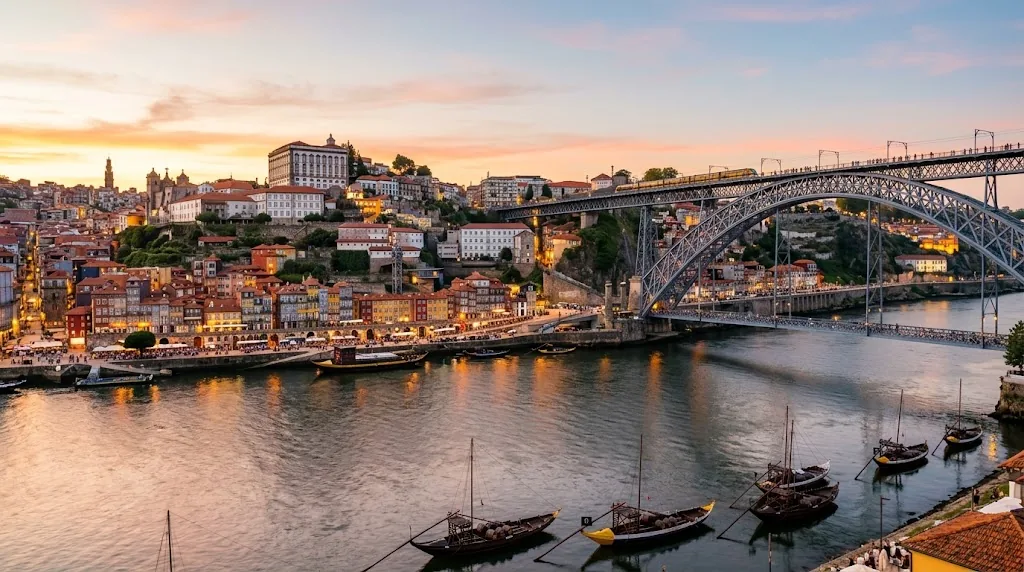
Many itineraries treat the two cities as interchangeable stops a few hours apart by train. The rain says otherwise. From November to January Porto receives 20.2 inches (513 mm) of rain, which is close to Lisbon's entire year. In January alone Porto gets 6.5 inches (165 mm) over 13 rainy days, against 2.5 inches (64 mm) and 9 rainy days in Lisbon. If you only have a winter window, put Lisbon first and treat Porto as the gamble.
In summer the gap nearly vanishes. From June to August Lisbon collects 0.8 inches (20 mm) and Porto 3.3 inches (84 mm). July and August are almost completely dry in both, with 1 rainy day each in Lisbon and 4 and 3 in Porto.
Spring, April to early June: green, mild and slightly unpredictable
April is lovely and not yet reliable. Lisbon is 65.8°F (18.8°C) with 9 rainy days and 11.3 hours of sun, while Porto has 12 rainy days and 5.0 inches (127 mm). Pack a rain jacket and do not plan every day around the outdoors. By May the picture improves quickly in Lisbon, which drops to 4 rainy days and 1.4 inches (36 mm) at 71.4°F (21.9°C). Porto in May is still a little wet, with 10 rainy days and 3.3 inches (84 mm), but 68.4°F (20.2°C) and 12.1 hours of sun make that easy to live with.
June is where spring turns into summer. It also brings the city festivals: Lisbon celebrates its popular saints in June, and Porto's São João night around June 23 to 24 is the biggest party of the year there. Expect crowds, grilled sardines and tight accommodation in those weeks.
July and August: dry, hot and busy
Lisbon in July averages 80.4°F (26.9°C), and in August 81.7°F (27.6°C), with 13.4 and 12.6 hours of sun and almost no rain (0.1 inches, or 3 mm, each month). Humidity is only 69% and 68%. Those are good numbers for a beach week and tiring numbers for climbing Lisbon's hills at midday. Porto is a more comfortable 77.0°F (25.0°C) and 77.9°F (25.5°C). The Atlantic is cold even in August, which surprises people expecting Mediterranean water.
Inland Portugal, including the Alentejo plains and the Douro valley, usually gets noticeably hotter than either city in midsummer. We have no figures for it, but we would not schedule a long hiking or vineyard-walking itinerary there in July or August. These are also the busiest months on the coast, so book early.
September and October: the sweet spot, then a cliff
September is the one month where both cities score well on everything. Lisbon gets 1.2 inches (30 mm) over 4 rainy days, Porto 2.6 inches (66 mm) over 6, and the sea has had all summer to warm up. The grape harvest in the Douro usually runs from September into early October, which gives the month a purpose beyond the weather.
October splits the two cities. Lisbon is still pleasant at 72.3°F (22.4°C) with 9 rainy days, but Porto jumps to 6.8 inches (173 mm) over 12 rainy days, a 4.2 inch (107 mm) increase on September. If your trip covers both cities in October, plan indoor time in Porto, and look at Lisbon in October for the sunnier half.
Winter, November to March: mild, grey and cheap
Winter in Portugal is mild rather than cold. Lisbon in December averages a 58.8°F (14.9°C) high and a 50.0°F (10.0°C) low, with 9 rainy days and 7.4 hours of sun. Porto is 57.0°F (13.9°C), with a 46.0°F (7.8°C) low, and its sunshine falls to 6.6 hours a day. We would skip Porto from October to December unless the main goal is museums, cafes and port cellars. Lisbon in February, at 59.0°F (15.0°C) with 8 rainy days and 8.5 hours of sun, is a very reasonable city break for a visitor from colder places, and prices are usually lower than in summer. For a wider winter comparison, see where in Europe is warm in January.
The best time to go to Portugal on a first trip
A first visit usually means Lisbon, Porto and a day trip or two, so the question is how to stack them. In September we would do Porto first and Lisbon last: Porto is the wetter of the two (6 rainy days against 4), so you take the risk early and finish in the sunnier city. In June the logic holds even more strongly, because Porto has 7 rainy days and Lisbon has 3.
In May, reverse it if you can. Lisbon is dependable by then at 4 rainy days, and Porto's 10 rainy days and 3.3 inches (84 mm) argue for keeping a spare day in the schedule. Seven days is enough for the pair with some slack. Ten lets you add a coastal stop or a Douro day without rushing, and it also gives you room to swap a rainy day for a dry one.
Daylight and sunshine through the year
Sun matters more than temperature in Portugal, because the temperatures stay moderate almost all year. Lisbon moves from 7.4 hours of sun a day in December to 13.4 in June and July, which is close to double. Porto goes from 6.6 hours in December and January to 13.5 in July. A winter day trip therefore has a short usable window, and dusk comes early. In summer the opposite is true: the light lasts into the evening, which is why dinner is late and why the terraces fill after 8 pm.
If you take photos, the soft light of late afternoon in September and October is hard to beat, and the cooler months have far fewer visitors in the same viewpoints. April has 11.3 hours of sun in Lisbon and 10.9 in Porto, which is plenty, but it also has the most changeable skies.
Holidays, Easter and local crowd patterns
Easter falls in March or April depending on the year, and Holy Week brings processions and a lot of domestic travel. That can mean full trains and higher prices at the very point when April weather is still unsettled. August is when Portuguese families themselves take their holidays, so the coast and the small towns fill up with locals as well as foreign visitors. The quietest sensible windows are early May and late September into the first days of October, before Porto's rain arrives. The best time to go to Portugal is also a popular time, so book September flights and rooms early.
Beyond Lisbon and Porto
The Algarve, on the south coast, is usually the sunniest and warmest part of the mainland and is the usual choice for winter sun and long beach seasons. Madeira has a mild subtropical climate through most of the year, and the Azores are greener, cloudier and more changeable. Big-wave surfing at Nazaré is a winter spectacle, which is the opposite of what a beach visitor wants. None of these places are in our data, so treat those descriptions as general guidance and check a local forecast before booking.
Choosing by what you want from the trip
- Beaches and swimming: July to September. Lisbon in August has 12.6 hours of sun and 1 rainy day. Remember the Atlantic stays cool.
- Sightseeing on foot: May, June and September. Lisbon's hills are much easier at 71°F to 78°F than at 82°F.
- Cheapest trip: January and February, with Lisbon as the base. Porto in those months has 11 to 13 rainy days.
- Families with school-age children: June, or the first half of September, when it is warm without the August crowds.
- Avoiding crowds: May and late September, the best time to go to Portugal if you dislike queues. For a Europe-wide comparison, try Barcelona, which has a similar pattern.
What to pack
For June to September, light layers, a sun hat and a thin sweater for evenings are enough. Lisbon's September lows are 64.0°F (17.8°C), so nights stay warm. In spring and autumn add a waterproof jacket and shoes with grip, because Lisbon's cobbled streets and tram tracks are slippery when wet. For December to February, highs hover around 57°F to 59°F, so think a light coat, not a parka. Our guide to what to wear in 60-degree weather fits Portuguese winters well.
How we picked these months
We compared comfort (highs between roughly 68°F and 82°F), rainy days and hours of sun for each month, then used crowd patterns to break ties, which is how we settled on September as the best time to go to Portugal overall. The data is a 20-year average from 2006 to 2025 using the Open-Meteo Historical Weather API. It tells you what is typical, not what will happen in a given week. If you want help matching dates to weather, the trip planner can narrow it down. One practical tip to finish: if you are visiting in the shoulder months, book Porto last and keep a flexible day or two so you can swap it for a dry one.
Frequently asked questions
What is the best month to visit Portugal?
September is our pick. Lisbon averages 77.9°F (25.5°C) with 4 rainy days and 11.1 hours of sun, and Porto averages 75.4°F (24.1°C) with 6 rainy days. June is a close second, with 3 rainy days in Lisbon and 7 in Porto.
When is the cheapest time to go to Portugal?
Prices are usually lowest from November to February. Lisbon is the better winter base, with a 57.4°F to 59.0°F (14.1°C to 15.0°C) high and 8 to 9 rainy days in January and February, while Porto has 11 to 13 rainy days in those months.
Is Portugal too hot in August?
Lisbon is hot but dry in August, with a 81.7°F (27.6°C) high, 1 rainy day and 12.6 hours of sun. Porto is milder at 77.9°F (25.5°C). The inland Alentejo and Douro regions are usually hotter than either city, so plan indoor time at midday.
How rainy is Porto compared with Lisbon?
Porto is much wetter. It receives about 52 inches (1,313 mm) of rain a year against about 23 inches (584 mm) in Lisbon. In January Porto gets 6.5 inches (165 mm) over 13 rainy days, while Lisbon gets 2.5 inches (64 mm) over 9.