Best Time to Visit Germany: Weather in Berlin, Munich and Hamburg
The best time to visit Germany is June or September: Berlin averages 73.6F (23.1C) with 12.4 hours of sun in June, while Munich gets 16 rainy days in May. Numbers cover Berlin, Munich and Hamburg.
Germany does not reward a one-size-fits-all answer, but the best time to visit Germany for most trips is June or September, with the broader window running from late May to the end of September. In June, Berlin averages 73.6F (23.1C) with 12.4 hours of sun a day, and Hamburg manages 70.3F (21.3C) and 12.0 hours. Munich is the outlier: June brings 71.4F (21.9C) but also 14 rainy days and 4.6 in (117 mm) of rain.
The numbers on this page cover three cities only: Berlin, Munich and Hamburg, using WeatherApex 20-year averages from 2006 to 2025. That gives you the east, the south and the north coast side of the country. It does not include the Rhine valley, Cologne, Frankfurt, Dresden, the Black Forest or the Alps themselves, which we mention only in general terms, without figures.
Best Time to Visit Germany: Quick Answer by City
These are the months we would book first for each city. Notice how much the rainy-day count varies for the same warm weather.
| City and month | Avg high F (C) | Avg low F (C) | Rainy days | Sun hours per day |
|---|---|---|---|---|
| Berlin, June | 73.6 (23.1) | 56.3 (13.5) | 10 | 12.4 |
| Berlin, September | 68.2 (20.1) | 53.1 (11.7) | 8 | 8.9 |
| Munich, June | 71.4 (21.9) | 54.5 (12.5) | 14 | 11.5 |
| Munich, September | 66.0 (18.9) | 50.2 (10.1) | 12 | 8.7 |
| Hamburg, June | 70.3 (21.3) | 54.3 (12.4) | 12 | 12.0 |
| Hamburg, September | 66.4 (19.1) | 53.1 (11.7) | 10 | 8.6 |

Our reading: Berlin is the most forgiving city in summer, Hamburg is the one where you should always carry a jacket, and Munich is the one with the thunderstorms. If you are only going to one place, that already tells you something about when to go.
Best Time to Visit Germany: The Quick Answer
March is cold and grey. Berlin averages 48.4F (9.1C) with a low of 33.8F (1.0C), Munich 49.5F (9.7C) with a low barely above freezing at 32.4F (0.2C), and Hamburg 48.0F (8.9C). Sun hours do climb to 7.1 to 8.1 a day, though, and 10 to 12 rainy days is still a lot. We would only go in March for a city break built around museums.
April is where Germany starts to feel like a different country. Highs sit between 56.8F and 58.1F (13.8C to 14.5C) in all three cities, and the sun is out for 10.0 to 10.2 hours a day. Berlin is the driest at 1.3 in (33 mm) over 8 rainy days; Munich gets 2.4 in (61 mm) over 11. It is a good month for walking cities, with trees in leaf and no summer crowds. Pack for showers.
May splits the country. Berlin reaches 66.2F (19.0C) with 10 rainy days and 2.1 in (53 mm), which is quite pleasant. Munich, though, records 4.7 in (119 mm) over 16 rainy days, the wettest month in any of the three cities. If your trip is Munich-focused, May in Munich is a damp bet, and we would move to April or June.
Summer: June to August
June is our favorite. It has the longest days, Berlin's sunniest month (12.4 hours), and the rain is manageable: Berlin 2.5 in (64 mm) over 10 days, Hamburg 2.8 in (71 mm) over 12. A light jacket in the evening is still useful, as lows are 54.3F to 56.3F (12.4C to 13.5C). See Berlin in June if you are building a trip around the capital.
July and August are the warmest months, but warm is relative. Berlin tops out at 76.1F (24.5C) in July and 75.7F (24.3C) in August. Munich reaches 74.7F (23.7C) and 73.8F (23.2C). Hamburg stays cooler, at 73.2F (22.9C) and 72.5F (22.5C). These are not hot figures, so shorts-only packing is a mistake. The catch is rain. July is the wettest month in Berlin (3.4 in, 86 mm, 12 rainy days), and Hamburg gets 15 rainy days. Munich has 15 rainy days in both July and August, with more than 4 in (109 mm to 114 mm) of rain. Heavy thunderstorms are common, and a sunny morning often turns into a wet afternoon.
That does not make summer bad. Beer gardens, lake swimming and long evenings are the point of a German summer, and the sun is out for 10.6 to 12.4 hours a day from June to August. Just do not plan an outdoor-only schedule, and keep a covered fallback for each day.

Autumn: September to November
September is the month that surprises people. Berlin drops to 68.2F (20.1C) but has only 8 rainy days and 1.8 in (46 mm), tied with April for its fewest rainy days of the year. Hamburg has 10 rainy days and 2.2 in (56 mm). Munich is still showery with 12 days and 3.4 in (86 mm), but cooler air comes with clearer light. Oktoberfest usually starts in the second half of September and runs into early October, so Munich hotels book out early. September in Munich averages 66.0F (18.9C), which suits a long afternoon in a tent or beer garden.
October is where we would start to be cautious. Berlin falls to 57.4F (14.1C) with a 45.9F (7.7C) low, and sun hours drop to 5.9 in Berlin and 5.7 in Hamburg. Munich is a little better, with 6.8 hours and 58.1F (14.5C). Fall colors can be lovely, but plan for gloom on at least some days. If you are weighing options for that month, the best places to visit in October shows warmer alternatives.
November is dim and damp: Berlin 46.9F (8.3C) with 87% humidity and 3.9 hours of sun; Hamburg 47.3F (8.5C) with 3.4 hours. Fine for a short trip with museums and cafes, not the month to build a walking holiday around. Christmas markets usually begin in late November, which helps the mood if not the weather.
Winter: December to February
Winter is real in Germany. January in Munich averages a high of 38.8F (3.8C) and a low of 26.8F (-2.9C), which is the coldest low among the three cities. Berlin is 37.9F (3.3C) by day and 29.5F (-1.4C) at night; Hamburg is 39.6F (4.2C) and 32.0F (0.0C). Humidity is high everywhere, between 81% and 86%, so it feels colder than the numbers suggest.
The bigger issue is light. Berlin gets 2.6 hours of sun a day in December and 3.1 in January, Hamburg 2.3 and 2.9. Munich is better at 4.4 and 4.7. Expect many days without much sunshine at all. Still, December in Germany is a destination in its own right for Christmas markets, which usually run from late November until just before Christmas. If that is your reason to go, choose early December (see Munich in December or Berlin in December) and dress for 40F (4C) weather.
We would skip Hamburg in December unless you love moody harbor weather: 14 rainy days, 88% humidity and 2.3 hours of sun make it the dimmest combination in the data. For the Alps and ski areas, the cities above are only a loose guide, as mountain conditions are colder and snowier; we have no figures for them.
The Full Temperature Picture
Here are the monthly highs and lows side by side, in Fahrenheit with Celsius in brackets.
| Month | Berlin high / low F (C) | Munich high / low F (C) | Hamburg high / low F (C) |
|---|---|---|---|
| January | 37.9 / 29.5 (3.3 / -1.4) | 38.8 / 26.8 (3.8 / -2.9) | 39.6 / 32.0 (4.2 / 0.0) |
| February | 41.2 / 30.4 (5.1 / -0.9) | 42.4 / 27.5 (5.8 / -2.5) | 41.9 / 32.4 (5.5 / 0.2) |
| March | 48.4 / 33.8 (9.1 / 1.0) | 49.5 / 32.4 (9.7 / 0.2) | 48.0 / 34.3 (8.9 / 1.3) |
| April | 58.1 / 40.8 (14.5 / 4.9) | 57.9 / 39.0 (14.4 / 3.9) | 56.8 / 40.3 (13.8 / 4.6) |
| May | 66.2 / 48.9 (19.0 / 9.4) | 63.9 / 46.8 (17.7 / 8.2) | 64.0 / 47.7 (17.8 / 8.7) |
| June | 73.6 / 56.3 (23.1 / 13.5) | 71.4 / 54.5 (21.9 / 12.5) | 70.3 / 54.3 (21.3 / 12.4) |
| July | 76.1 / 59.7 (24.5 / 15.4) | 74.7 / 57.6 (23.7 / 14.2) | 73.2 / 57.9 (22.9 / 14.4) |
| August | 75.7 / 59.4 (24.3 / 15.2) | 73.8 / 56.8 (23.2 / 13.8) | 72.5 / 57.7 (22.5 / 14.3) |
| September | 68.2 / 53.1 (20.1 / 11.7) | 66.0 / 50.2 (18.9 / 10.1) | 66.4 / 53.1 (19.1 / 11.7) |
| October | 57.4 / 45.9 (14.1 / 7.7) | 58.1 / 43.2 (14.5 / 6.2) | 57.2 / 46.8 (14.0 / 8.2) |
| November | 46.9 / 38.3 (8.3 / 3.5) | 47.3 / 34.5 (8.5 / 1.4) | 47.3 / 39.6 (8.5 / 4.2) |
| December | 40.5 / 33.1 (4.7 / 0.6) | 40.5 / 29.3 (4.7 / -1.5) | 41.7 / 34.9 (5.4 / 1.6) |
Notice that Berlin and Munich are within about 2 degrees of each other for most of the year, while Hamburg is the mildest in winter and the coolest in summer. The sea influence is steady, but not dramatic.
Rainy Days and Sunshine by City
This is the table that should decide your dates. Each cell shows the number of rainy days in the month followed by average hours of sun per day.
| Month | Berlin rainy days, sun per day | Munich rainy days, sun per day | Hamburg rainy days, sun per day |
|---|---|---|---|
| January | 13 days, 3.1 h | 13 days, 4.7 h | 13 days, 2.9 h |
| February | 10 days, 4.9 h | 11 days, 6.2 h | 11 days, 4.6 h |
| March | 11 days, 7.3 h | 12 days, 8.1 h | 10 days, 7.1 h |
| April | 8 days, 10.1 h | 11 days, 10.0 h | 10 days, 10.2 h |
| May | 10 days, 11.3 h | 16 days, 10.1 h | 12 days, 11.1 h |
| June | 10 days, 12.4 h | 14 days, 11.5 h | 12 days, 12.0 h |
| July | 12 days, 11.9 h | 15 days, 11.9 h | 15 days, 11.6 h |
| August | 10 days, 11.0 h | 15 days, 10.6 h | 14 days, 10.6 h |
| September | 8 days, 8.9 h | 12 days, 8.7 h | 10 days, 8.6 h |
| October | 10 days, 5.9 h | 11 days, 6.8 h | 13 days, 5.7 h |
| November | 10 days, 3.9 h | 10 days, 5.2 h | 12 days, 3.4 h |
| December | 12 days, 2.6 h | 13 days, 4.4 h | 14 days, 2.3 h |
Look for months with fewer than 10 rainy days and more than 8 hours of sun. Only Berlin hits that mark, in April (8 days, 10.1 hours) and September (8 days, 8.9 hours). Munich and Hamburg usually need you to accept a wetter day or two.
Choosing by Goal
City sightseeing
For the best time to visit Germany on a city break, we would pick Berlin in June or September, Munich in April or June, Hamburg in June. Berlin offers the best balance of weather and daylight, so it is a safe choice for a first trip.
Cheapest time
January and February are generally the lowest-priced months for hotels in the big cities, outside of trade fairs. You trade price for cold: highs of 37.9F to 42.4F (3.3C to 5.8C) and 2.9 to 6.2 hours of sun.
Christmas markets
Go in the first half of December, when markets are open, daylight is short but the evenings are the point, and highs are 40.5F to 41.7F (4.7C to 5.4C). Pack hats, gloves and waterproof boots; wet pavement is common.
Oktoberfest and beer gardens
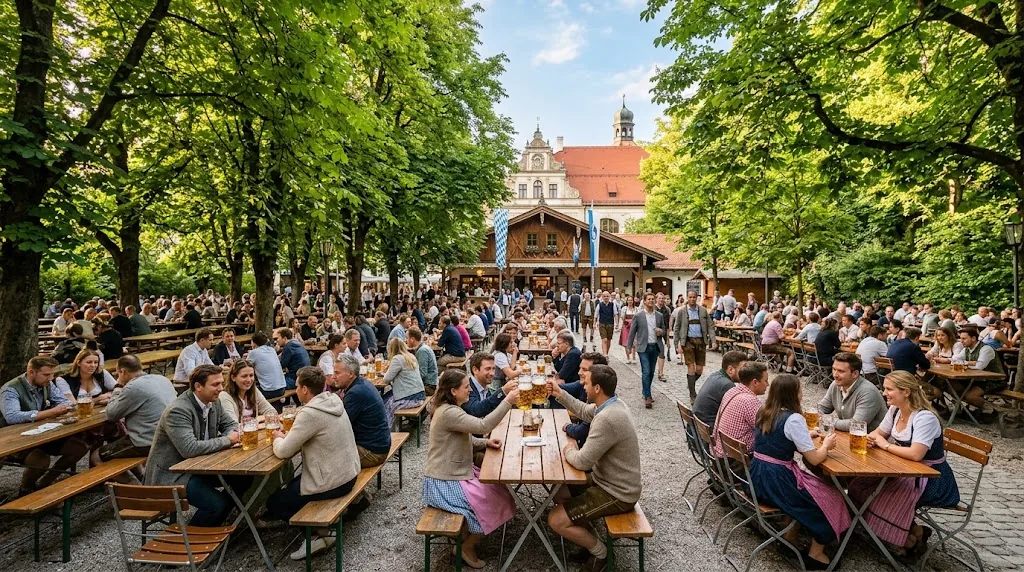
Late September for Oktoberfest, June to August for beer gardens. Book accommodation months ahead for the festival. For an autumn alternative, see Munich in September.
Families
June, or the first half of September. Daylight is long, temperatures are comfortable at 66F to 74F (19C to 23C), and school holidays (which vary by state, and usually run through summer) have not yet fully started or have just ended.
Avoiding crowds
April, early May and October are the quieter stretches in most cities, which also means a higher chance of damp weather. Festival weeks and the Christmas markets draw the biggest numbers, so book those far ahead or avoid them.
What to Pack
The one rule that works all year is layers and a compact umbrella. In summer, bring T-shirts, a light sweater and a rain jacket. Spring and autumn call for a medium jacket and waterproof shoes; our page on what to wear in 60 degree weather is a decent starting point. In winter you need a warm coat, hat, gloves and boots with grip, and the tips for 40 degree weather apply to most December days.
Pairing Germany With Other Countries
The best time to visit Germany overlaps with its neighbors, so combining countries is easy. For an Alpine add-on, see the Switzerland guide, and for a western Europe loop, France follows a similar late spring and early autumn pattern.
How We Picked: A Data Note
Everything above comes from 20-year averages for Berlin, Munich and Hamburg (2006 to 2025). They tell you what is typical, not what will happen on a specific week. German weather can shift quickly, and a cold June or a hot September is entirely possible. Use the averages to pick your window, then check the forecast a few days out. The trip planner can help you compare dates, and the overviews for Berlin, Munich and Hamburg show each city in full.
If we had to give one instruction for your best time to visit Germany: pick June or the first half of September, choose Berlin if the weather matters most, and always book at least one indoor plan for each day. The weather figures come from the Open-Meteo archive.
Frequently asked questions
What is the best month to visit Germany?
June is the strongest choice for the cities we cover. Berlin averages 73.6F (23.1C) with 12.4 hours of sun and 10 rainy days, and Hamburg is 70.3F (21.3C). Munich is 71.4F (21.9C) but has 14 rainy days, so September (66.0F, 12 days) can suit it better.
When does it rain most in Germany?
Summer is the wettest season in Munich, with 4.3 to 4.6 in (109 to 117 mm) from June to August and 15 rainy days in July and August. May is Munich's wettest month at 4.7 in (119 mm) over 16 rainy days. Berlin peaks in July at 3.4 in (86 mm).
How cold is Germany in winter?
January highs are 37.9F (3.3C) in Berlin, 38.8F (3.8C) in Munich and 39.6F (4.2C) in Hamburg. Munich is the coldest at night, with an average low of 26.8F (-2.9C). Sunshine is limited to 2.9 to 4.7 hours a day.
Is September a good month to visit Germany?
Yes, particularly for Berlin, which has 8 rainy days, 1.8 in (46 mm) of rain and a 68.2F (20.1C) high. Hamburg averages 66.4F (19.1C) with 10 rainy days. Munich is 66.0F (18.9C) with 12 rainy days, and Oktoberfest usually starts in the second half of the month.