Best Time to Visit South Africa: Cape Town and Johannesburg by Month
The best time to visit South Africa is usually April, May or September, with Cape Town at 72.1F (22.3C) in April and Johannesburg down to 3 rainy days in September. Seasons are reversed, so December is midsummer and June is the Cape's wettest month at 4.4 inches (112 mm).
The best time to visit South Africa for most first trips is April, May or September. In April Cape Town averages 72.1F (22.3C) with 4 rainy days, in September 64.2F (17.9C) with 7, and Johannesburg is dry and sunny, with just 3 rainy days in both September and May. Summer (December to February) is warmer and better for the Cape beaches, but Johannesburg gets 13 to 17 rainy days a month then.
First, the point that trips people up: this is the southern hemisphere, so the seasons are reversed. December is midsummer, July is midwinter, and "spring" means September to November. The figures here cover two cities only, Cape Town and Johannesburg, taken from 20-year averages (2006 to 2025). They do not cover Kruger, Durban, the Garden Route or the Drakensberg, so for those we stick to well-known general patterns and give no numbers.
Best Time to Visit South Africa at a Glance
The table below puts the two cities side by side, because they behave like different countries. Cape Town gets its rain in winter and is bone dry in summer. Johannesburg is the opposite: wet summer afternoons, then a dry, sunny, cold-at-night winter. Temperatures are average daily highs and lows in Fahrenheit with Celsius in brackets.
| Month | Cape Town high | Cape Town low | Cape Town rainy days | Cape Town sun hrs/day | Johannesburg high | Johannesburg low | Johannesburg rainy days | Johannesburg sun hrs/day |
|---|---|---|---|---|---|---|---|---|
| January | 78.6F (25.9C) | 63.7F (17.6C) | 3 | 13.4 | 76.8F (24.9C) | 58.3F (14.6C) | 15 | 11.3 |
| February | 78.6F (25.9C) | 64.0F (17.8C) | 2 | 12.4 | 76.6F (24.8C) | 57.9F (14.4C) | 13 | 11.1 |
| March | 76.1F (24.5C) | 61.7F (16.5C) | 4 | 11.2 | 74.3F (23.5C) | 55.2F (12.9C) | 12 | 10.5 |
| April | 72.1F (22.3C) | 57.7F (14.3C) | 4 | 9.9 | 69.3F (20.7C) | 49.6F (9.8C) | 8 | 9.9 |
| May | 66.7F (19.3C) | 54.0F (12.2C) | 8 | 8.7 | 66.4F (19.1C) | 43.9F (6.6C) | 3 | 9.8 |
| June | 62.8F (17.1C) | 50.9F (10.5C) | 11 | 8.1 | 61.9F (16.6C) | 38.5F (3.6C) | 1 | 9.7 |
| July | 61.5F (16.4C) | 49.3F (9.6C) | 10 | 8.5 | 62.2F (16.8C) | 37.4F (3.0C) | 1 | 10.1 |
| August | 61.7F (16.5C) | 49.6F (9.8C) | 10 | 9.2 | 68.2F (20.1C) | 42.1F (5.6C) | 1 | 10.5 |
| September | 64.2F (17.9C) | 51.6F (10.9C) | 7 | 10.2 | 75.9F (24.4C) | 49.1F (9.5C) | 3 | 11.2 |
| October | 69.4F (20.8C) | 55.4F (13.0C) | 5 | 12.0 | 77.5F (25.3C) | 52.7F (11.5C) | 10 | 11.1 |
| November | 72.3F (22.4C) | 58.1F (14.5C) | 5 | 12.5 | 76.8F (24.9C) | 55.2F (12.9C) | 13 | 11.1 |
| December | 75.7F (24.3C) | 61.5F (16.4C) | 4 | 13.3 | 77.0F (25.0C) | 57.9F (14.4C) | 17 | 11.3 |
Two things jump out. Cape Town in January has 13.4 hours of sun a day and 3 rainy days, against 8.1 hours and 11 rainy days in June. And Johannesburg swings from 17 rainy days in December to just 1 in June and July.
Best Time to Visit South Africa: The Quick Answer
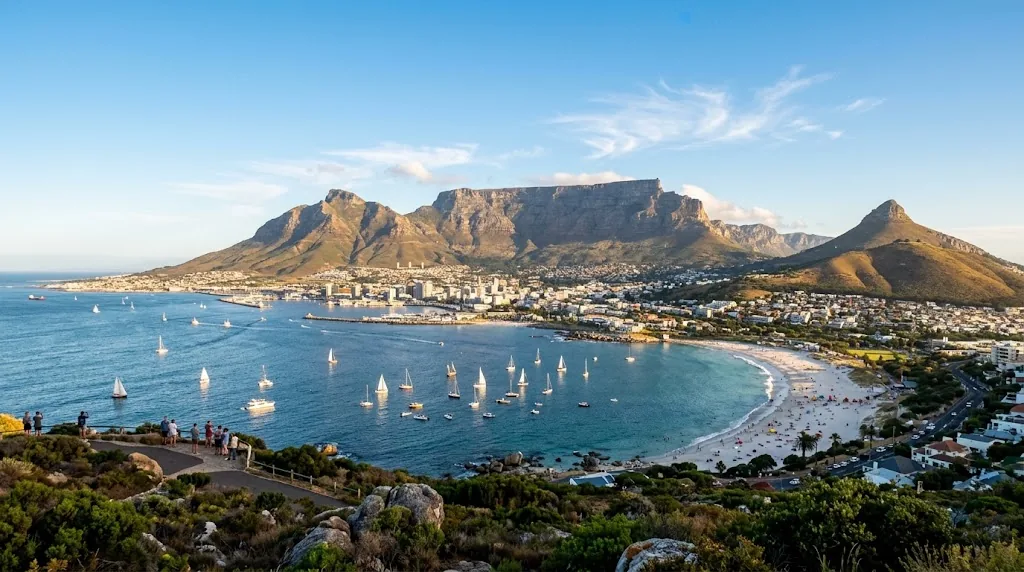
This is when the Western Cape looks the way it does on postcards. Cape Town averages 75.7F (24.3C) in December and 78.6F (25.9C) in both January and February, with lows around 61F to 64F (16.4C to 17.8C) and very little rain: 0.4 inches (10 mm) in January and 0.5 inches (13 mm) in February. Sun hours are the best of the year at 12.4 to 13.4 a day. If your trip is mostly beaches, wine estates and long evenings on a terrace, February in Cape Town is hard to beat.
The honest downsides. It is peak season, so flights, rooms and rental cars cost more and the popular spots fill up, especially around Christmas and New Year when South African families are on holiday too. The Cape is also famously windy in summer, and the south-easterly can shut the cable car on Table Mountain on some days, which is a nuisance if you have only a few days. Book that morning-of rather than weeks ahead.
Johannesburg in the same months is a different story. Highs are a pleasant 76.6F to 77.0F (24.8C to 25.0C), but December and January each bring 5.1 inches (130 mm) of rain over 15 to 17 days, nearly always as afternoon thunderstorms. They are short and dramatic and the mornings are usually fine. It is not a bad time for a city stay. It is a poor time to count on a long outdoor day.
Autumn, March to May: our favorite shoulder season
If we had to pick one stretch, it would be late March to April. Cape Town is still warm at 76.1F (24.5C) in March and 72.1F (22.3C) in April, rain is 0.9 and 1.3 inches (23 and 33 mm), and there are only 4 rainy days in each month. The summer crowds thin out and prices ease. Sun hours drop to 11.2 in March and 9.9 in April, which is still plenty.
Johannesburg is in transition. March is still wet (12 rainy days, 3.0 inches or 76 mm), April falls to 8 rainy days and 69.3F (20.7C), and by May it is down to 3 rainy days and 0.6 inches (15 mm), with a 66.4F (19.1C) high. Humidity drops from 67% in March to 55% in May. May is one of the quietly good months for Johannesburg and the northern safari areas, but the Cape starts to turn: May in Cape Town has 8 rainy days and 2.6 inches (66 mm), so the first winter fronts have arrived.
Winter, June to August: dry for safari, wet in the Cape
Winter is the season to understand before you book, because the same weather is a plus in one place and a minus in another.
In Cape Town, June is the wettest month of the year with 4.4 inches (112 mm) and 11 rainy days. Highs are 61.5F to 62.8F (16.4C to 17.1C) and lows drop to about 49F to 51F (9.6C to 10.5C). Sun is down to 8.1 hours a day in June. It is not a freezing winter, just grey, damp and breezy, and some days are clear and crisp between the fronts. The upside is cheaper rooms, empty restaurants and the whale season along the coast, which usually runs from about June to November.
Johannesburg in winter is the surprise. June and July have 1 rainy day each and almost no rain (0.3 and 0.1 inches, 8 and 3 mm), with 9.7 to 10.1 sun hours and humidity of 51% and 47%. Days reach 61.9F to 62.2F (16.6C to 16.8C). Nights are cold: the July low is 37.4F (3.0C), and in the high interior it can be cold enough for frost on the coldest mornings. Pack a proper jacket. Do not assume Africa means warm nights.
August starts to turn. Johannesburg reaches 68.2F (20.1C), still just 1 rainy day, and humidity falls to 41%. Cape Town in August is still wet (3.3 inches, 84 mm, 10 rainy days), though the sun is back up to 9.2 hours.
Safari timing: when the bush is at its best
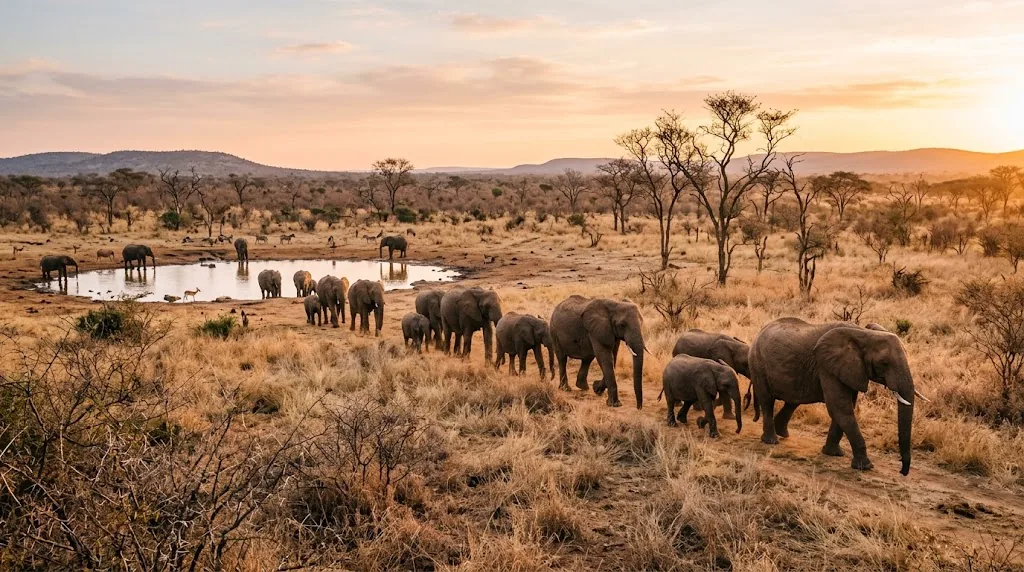
Our data covers Cape Town and Johannesburg, not the game reserves, so the best time to visit South Africa for wildlife is general knowledge here, not figures. The usual rule for Kruger and the surrounding private reserves is that the dry winter, roughly May to September, is the best time for wildlife viewing. Vegetation is thinner, so animals are easier to spot, and with surface water scarce they gather at rivers and waterholes. Mornings and evenings on an open vehicle are cold, though, so winter safari needs layers, a hat and gloves for the early drive.
The wet summer is greener, with newborn animals and excellent birding, but the bush is thicker and the days are hotter and stickier. Many people still prefer it for the lower prices and fewer vehicles at sightings. September and October are a good compromise: still dry, warmer, and the animals are concentrated at remaining water. That is also why Johannesburg's September numbers (75.9F or 24.4C, 3 rainy days, 39% humidity) make it such a handy gateway month.
Spring, September to November: warming up, with a catch
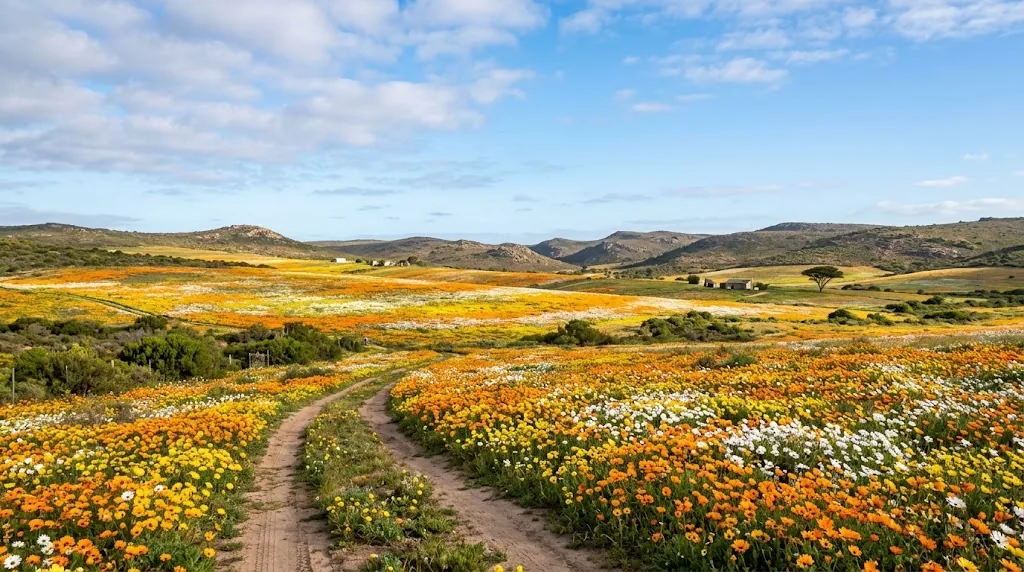
For many repeat visitors the best time to visit South Africa is September. Johannesburg is at 75.9F (24.4C) with only 3 rainy days and 11.2 hours of sun. Cape Town is cool at 64.2F (17.9C) with 7 rainy days and 1.7 inches (43 mm), but it is greening up, and the spring wildflower season on the West Coast usually peaks around August and September. Then October brings the wet season back to Johannesburg: 10 rainy days and 2.4 inches (61 mm), then 13 days in November.
Cape Town works the other way. October (69.4F or 20.8C, 5 rainy days, 12.0 sun hours) and November (72.3F or 22.4C, 5 rainy days, 12.5 sun hours) are lovely and the beaches are not yet crowded. You can see the logic of a split trip: Cape Town from October, with Johannesburg and safari kept to the early part of the stay.
Which month for which kind of trip
- Beach and outdoor Cape Town: January to March. Highs of 76.1F to 78.6F (24.5C to 25.9C), 2 to 4 rainy days.
- Cheapest, quietest: June to August for the Cape if you accept the rain. Lower prices come at the cost of 10 to 11 rainy days a month.
- Safari plus city: September, with Johannesburg at 3 rainy days, or May for lower crowds and a dry bush.
- Sightseeing and hiking: April or October to November in Cape Town, when 4 to 5 rainy days and highs from 69.4F to 72.3F (20.8C to 22.4C) make for easy walking.
- Families: December to January fits school holidays and the Cape beaches, but book far ahead. For a calmer family trip, March is warm with lighter crowds.
- Avoiding crowds: shoulder months, April, May, September and early November.
When we would skip it
We would avoid Cape Town in June for a first visit, if the plan depends on views and boat trips: 112 mm of rain over 11 days is a lot of grey. We would also avoid Johannesburg in December and January if you want a planned outdoor itinerary, since 130 mm of rain falls each month. And we would be wary of booking a winter safari without warm layers, especially if you are coming from a hot climate. Looking at July in Johannesburg, a 62.2F (16.8C) day is nice but a 37.4F (3.0C) night is not what most people pack for.
What to pack
Cape Town in summer needs sunscreen, a hat, a windproof layer and a sweater for evenings. Cape Town in winter needs a rain jacket and closed shoes, plus a mid-weight layer for the 50F (10C) nights. Johannesburg in summer calls for a light rain jacket kept in your day bag, and for winter a warm jacket and a hat for the early drive, with lighter clothes for the afternoon. If you are unsure what to wear at around 60F, our 60 degree weather guide helps, since much of the South African winter day sits there.
How we picked: a data note
The figures here are 20-year averages (2006 to 2025) from the Open-Meteo Historical Weather API, so they show what is typical, not what any single week will do. A given March can be wetter or drier than the average, and Cape Town in particular can have a clear winter day in the middle of a rainy month. The numbers cover Cape Town and Johannesburg only. For month-by-month detail on each, see the Cape Town weather and Johannesburg weather pages, and use the trip planner to compare your dates. If your plans also include another southern hemisphere country, our guides to Australia and Brazil use the same approach.
Our short version: if you can choose only one window for the best time to visit South Africa, go in April or September, book the Cape and the bush for different weeks, and keep a rain layer in your bag for whichever city you are in.
Frequently asked questions
What is the best month to visit South Africa?
April and September are our two favorites. Cape Town averages 72.1F (22.3C) in April with 4 rainy days, and Johannesburg has only 3 rainy days in September with a 75.9F (24.4C) high. Both months sit outside the main summer holiday crowds.
Is it summer in South Africa in December?
Yes, the seasons are reversed from the northern hemisphere. Cape Town averages 75.7F (24.3C) in December with 4 rainy days and 13.3 hours of sun. Johannesburg is warm at 77.0F (25.0C) but wet, with 17 rainy days and 5.1 inches (130 mm) of rain.
When is the coldest time in South Africa?
June and July are the coldest months in both cities. Johannesburg has a July low of 37.4F (3.0C) and a high of 62.2F (16.8C), with almost no rain. Cape Town is milder at 61.5F (16.4C) in July but much wetter, with 3.8 inches (97 mm) over 10 rainy days.
When does it rain most in Cape Town and Johannesburg?
Cape Town is wettest in winter, peaking in June at 4.4 inches (112 mm) over 11 rainy days. Johannesburg is wettest in summer, with 5.1 inches (130 mm) in both December and January, over 15 to 17 rainy days. The two cities are almost opposites.