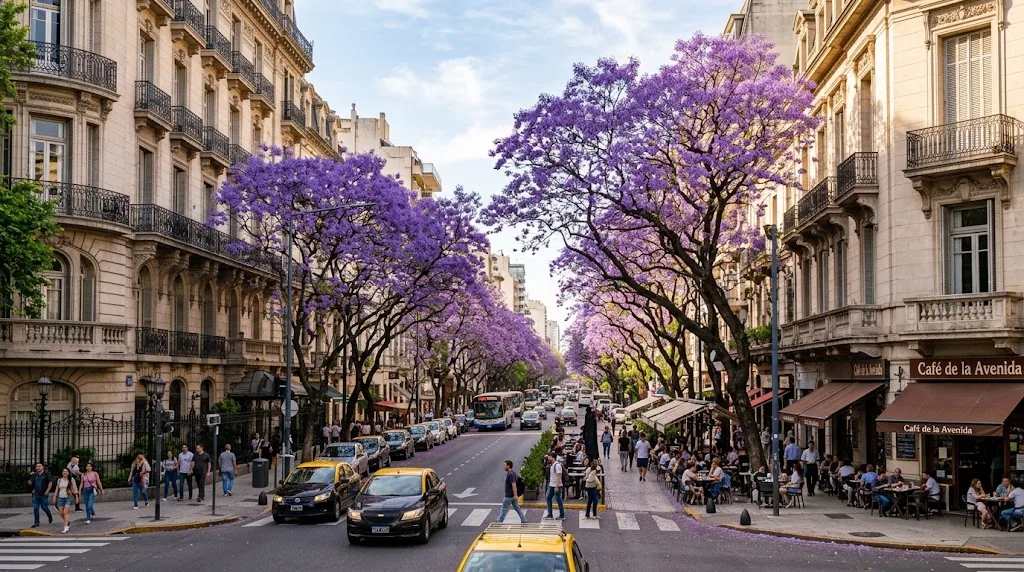

What January feels like in Buenos Aires
Summer peaks in January: no month in Buenos Aires is warmer (Buenos Aires is in the southern hemisphere, so the seasons run opposite to Europe and North America). Afternoons hit 28.3°C (82.9°F), the warmest of the year: sightseeing works best in the morning or evening. Nights fall to about 20.9°C (69.6°F), 7.4°C (13.3°F) below the afternoon, still warm enough for short sleeves. Humidity averages 67%, drier than usual here: hot spells feel a little sticky.
Rain in Buenos Aires in January
Expect rain on about 8 of 31 days, with dry spells in between; wet days bring about 9.7 mm (0.4 in), often as strong downpours, close to the city's usual 11.5 mm.
Daylight and sunshine in January
Long days: in mid-January, Buenos Aires gets 14 h 14 min of daylight, from sunrise near 5:55 am to sunset near 8:09 pm, 13 min less than in mid-December. Model estimates put sunshine at about 86% of daylight, on the sunnier side of the year here, so skies are mostly clear.
How January compares to the rest of the year
January is the warmest month of the year; afternoons are only 1.1°C (2°F) warmer than in December, with about the same rain. After this the year turns: February is already cooler, with highs near 27.3°C (81.1°F), and it gets wetter.
January in Buenos Aires: what 20 years show
Based on monthly averages from 2006–2025, not daily records.
Usual range
In most years January averages 27–29°C (81–85°F) in the afternoon, with 35–126 mm of rain. Rain falls about one day in 4 in an average January.
Records
| Record | Year | Avg high | Rain | Rainy days |
|---|---|---|---|---|
| Warmest January | 2023 | 29.7°C (85.5°F) | 41 mm | 7 |
| Coolest January | 2015 | 26.8°C (80.2°F) | 113 mm | 9 |
| Wettest January | 2014 | 28.5°C (83.3°F) | 181 mm | 11 |
| Driest January | 2009 | 28.3°C (82.9°F) | 22 mm | 6 |
Odds across years
In 8 of 20 years, January had 9 or more rainy days. In 4 of 20 years, it had under 40 mm of rain. In 4 of 20 years, the average high reached 29°C (84.2°F) or more. In 4 of 20 years, it stayed below 27.5°C (81.5°F).
January 2026 was the 6th warmest January since 2006, out of 21 years (28.7°C (83.7°F), 47 mm, 6 rainy days).
Who January suits
- Sightseeing: a good fit — warm but manageable for a city walk.
- Parks & outdoor: less ideal — afternoons are too warm to linger outside.
- Beach: less ideal — too many rainy days.
Tips for visiting Buenos Aires in January
Rain Protection
Rain can be heavy when it comes, so carry a light waterproof jacket.
Sun Protection
Loose, breathable clothing plus sunscreen and a wide-brimmed hat.
What to wear in Buenos Aires in January
These are estimates from monthly averages, so read each temperature as "around".
By time of day
- Morning, around 22°C (72°F): light clothes with a thin layer to start.
- Afternoon, around 28°C (83°F): light clothes, a hat and sunscreen.
- Evening, around 25°C (76°F): add the thin layer again.
Cooler year or hotter year
In a cooler year like 2015, January highs averaged 26.8°C (80.2°F), so a light extra layer is worth packing. In a hotter year like 2023 they reached 29.7°C (85.5°F), so keep your clothes light.
Packing for 7 days
Expect about 2 wet days in a week, often heavy, with about 9.7 mm (0.4 in) on each.
- Light, breathable clothes
- A thin layer for the morning and evening
- A packable rain jacket
- A hat, sunscreen and sunglasses
- Light, breathable shoes
Travelling on specific dates? Check your exact dates in the Trip Planner.
Quick questions
How warm is Buenos Aires in January?
Afternoons average 28.3°C (82.9°F) and nights about 20.9°C (69.6°F), hot by most people's standards; it is the warmest month of the year.
Does it rain a lot in Buenos Aires in January?
Yes: rain falls about one day in 4 and totals about 78 mm, often heavily, so plan some indoor options.
What should I wear in Buenos Aires in January?
Pack rain protection and sun protection, plus a layer for cool mornings and evenings.
Is January or February better for visiting Buenos Aires?
January scores slightly better on our climate ranking (#11 of 12 vs #12). February is cooler.