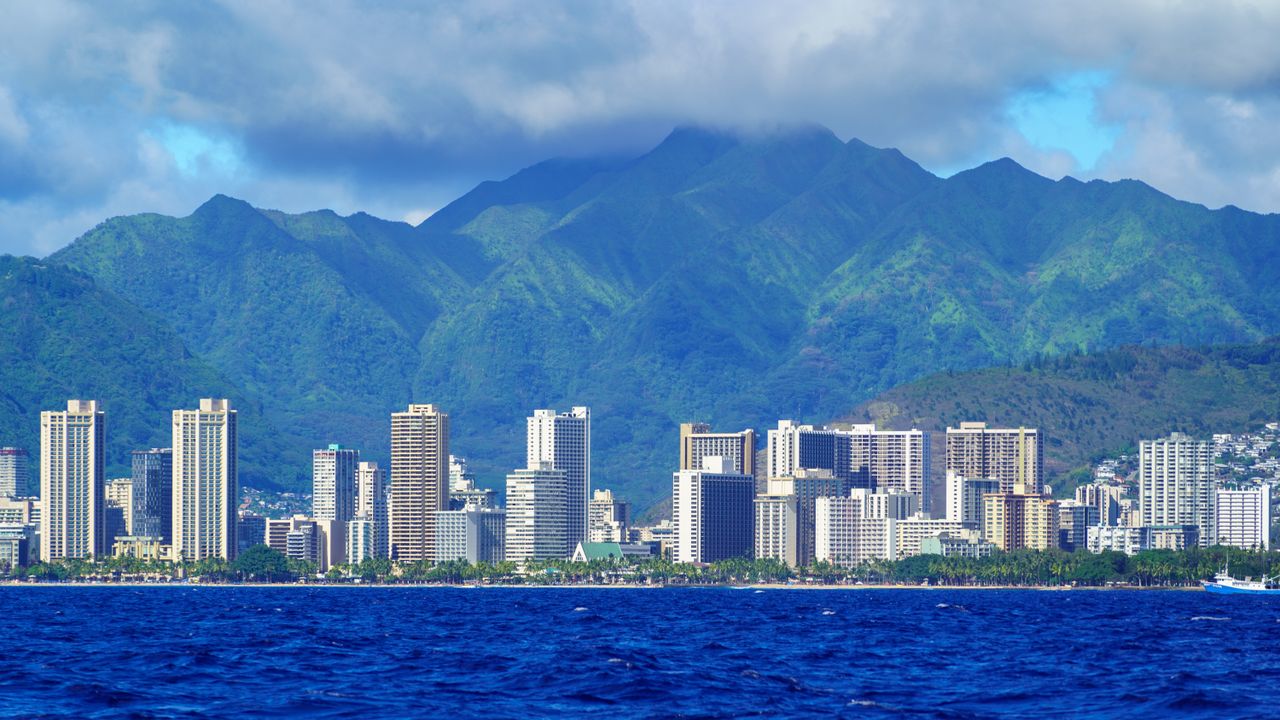
What January feels like in Honolulu
Honolulu lies in the tropics and stays warm all year, without a sharp split into seasons. Warm daytime weather invites long lunches outside and evening strolls. The gap between afternoon and night is small, so nights stay warm and the temperature hardly changes after dark. The air carries some moisture, so hot spells feel a little sticky.
Rain in Honolulu in January
Most days stay dry; rain arrives about one day in 4. Each rainy day adds about 5.7 mm (0.2 in), a proper wetting rather than a sprinkle. The yearly figure is similar, around 4.6 mm per wet day. It is among the three wettest months of the year.
Daylight and sunshine in January
In mid-January, sunrise is at about 7:11 am and sunset at about 6:09 pm (local time) — 10 h 58 min of daylight. Day length barely changes from mid-December (7 min longer). The sun is out for roughly 93% of those daylight hours, so skies are mostly clear.
How January compares to the rest of the year
January is the 3rd coolest month of the year in Honolulu. Compared with December, afternoons are 0.5°C (0.9°F) cooler, with 22 mm less rain. Temperatures barely move from one month to the next here. By February, typical highs are 24.5°C (76.1°F).
Who January suits
- Sightseeing: a good fit — comfortable enough to explore on foot all day.
- Parks & outdoor: a good fit — comfortable for long walks and picnics.
- Beach: less ideal — too many rainy days.
- Hiking: a good fit — mild temperatures for trails.
Tips for visiting Honolulu in January
Sunglasses
Plenty of sun, so bring sunglasses and a cap.
Quick questions
How warm is Honolulu in January?
It feels warm: typical highs are 24.9°C (76.8°F), with lows near 20.8°C (69.4°F).
Does it rain a lot in Honolulu in January?
Not especially. There are about 7 rainy days (40 mm), mostly moderate rain.
What should I wear in Honolulu in January?
Pack sunglasses. There is little need to change for the evening.
Is January or February better for visiting Honolulu?
January, narrowly: it ranks #1 of 12 among Honolulu's months, against #3 for the other. February has more rainy days.