Best Time to Visit Ireland and Scotland: Weather by Month and City
May and June are the best time to visit Ireland and Scotland, with June highs of 61.5°F to 63.7°F (16.4°C to 17.6°C) in Dublin, Cork, Edinburgh and Glasgow. Glasgow still sees 15 rainy days in June and 18 in August.
The best time to visit Ireland and Scotland together is May and June, with early September as a quieter backup. In June the four cities we track, Dublin, Cork, Edinburgh and Glasgow, average daytime highs of 61.5°F to 63.7°F (16.4°C to 17.6°C) and 10.0 to 11.3 hours of sun a day. That is as good as it gets on these islands, and it still comes with 12 to 15 rainy days.
Everything in this article comes from those four cities: Dublin and Cork for Ireland, Edinburgh and Glasgow for Scotland. We have no figures for the west coast, the Highlands or the islands, and anyone who has spent time there will tell you those places are often wetter and windier than the cities. Treat the numbers as a floor for the weather you should plan for, not a ceiling.
Best time to visit Ireland and Scotland in one table
These are 20 year averages from 2006 to 2025 for the three months we would actually pick.
| City and month | Avg high °F (°C) | Avg low °F (°C) | Rainy days | Sun hours per day |
|---|---|---|---|---|
| Dublin, May | 58.8 (14.9) | 47.5 (8.6) | 13 | 11.1 |
| Dublin, June | 63.7 (17.6) | 52.5 (11.4) | 14 | 11.3 |
| Dublin, September | 62.2 (16.8) | 52.3 (11.3) | 12 | 8.2 |
| Cork, May | 59.0 (15.0) | 47.3 (8.5) | 14 | 10.1 |
| Cork, June | 63.5 (17.5) | 52.0 (11.1) | 12 | 10.6 |
| Cork, September | 62.2 (16.8) | 52.2 (11.2) | 10 | 7.6 |
| Edinburgh, May | 56.7 (13.7) | 45.0 (7.2) | 14 | 10.5 |
| Edinburgh, June | 61.5 (16.4) | 50.0 (10.0) | 13 | 10.5 |
| Edinburgh, September | 60.3 (15.7) | 50.2 (10.1) | 12 | 7.6 |
| Glasgow, May | 57.9 (14.4) | 44.1 (6.7) | 15 | 10.0 |
| Glasgow, June | 62.1 (16.7) | 49.6 (9.8) | 15 | 10.0 |
| Glasgow, September | 60.1 (15.6) | 49.1 (9.5) | 14 | 7.0 |
The pattern behind the numbers
Ireland and Scotland sit in the path of Atlantic weather, which keeps winters mild and summers cool and means no month is reliably dry. The difference between a good trip and a miserable one is mostly how you handle the damp, not whether you avoid it. Look at the spread. In June, Cork has 12 rainy days while Glasgow has 15, a modest gap. In August the gap opens up: Cork has 13 rainy days, Glasgow has 18 and 4.8 in (122 mm) of rain.
Humidity tells the same story. It sits around 77% to 78% in June in all four cities and climbs to 90% in Glasgow in December. If you are used to dry heat, expect the cool air to feel wetter than the thermometer suggests.
Here is the year at a glance, in rainy days per month.
| Month (Rainy days) | Dublin | Cork | Edinburgh | Glasgow |
|---|---|---|---|---|
| January | 13 | 13 | 14 | 16 |
| February | 12 | 12 | 12 | 15 |
| March | 13 | 13 | 14 | 15 |
| April | 12 | 12 | 11 | 12 |
| May | 13 | 14 | 14 | 15 |
| June | 14 | 12 | 13 | 15 |
| July | 15 | 13 | 16 | 17 |
| August | 14 | 13 | 14 | 18 |
| September | 12 | 10 | 12 | 14 |
| October | 13 | 13 | 14 | 17 |
| November | 13 | 13 | 14 | 16 |
| December | 14 | 14 | 15 | 18 |
Ireland: Dublin and Cork
Ireland has the milder winters. Dublin in January averages 46.2°F (7.9°C) for the high and 38.1°F (3.4°C) for the low, while Cork is slightly warmer at 47.3°F (8.5°C). Cork is also wetter in the cold months: 4.5 in (114 mm) in October and 4.2 in (107 mm) in December, against 3.4 in (86 mm) and 3.2 in (81 mm) in Dublin.
Spring comes early enough to matter. By April Dublin reaches 53.6°F (12.0°C) with 9.7 hours of sun, and by May it is 58.8°F (14.9°C) with 11.1 hours of sun, close to its summer peak and more than either Scottish city gets in the same month. That makes late May our favourite single month for Dublin. St Patrick's Day on 17 March brings large crowds and higher hotel prices, but March itself is chilly, with a 39.6°F (4.2°C) low and 13 rainy days.
September is Cork's best month for dry odds: 10 rainy days, the lowest of the year for the city, though the 3.1 in (79 mm) of rain still falls in heavier bursts. Our notes in best time to visit Ireland cover the rest of the country in more detail.
Scotland: Edinburgh and Glasgow
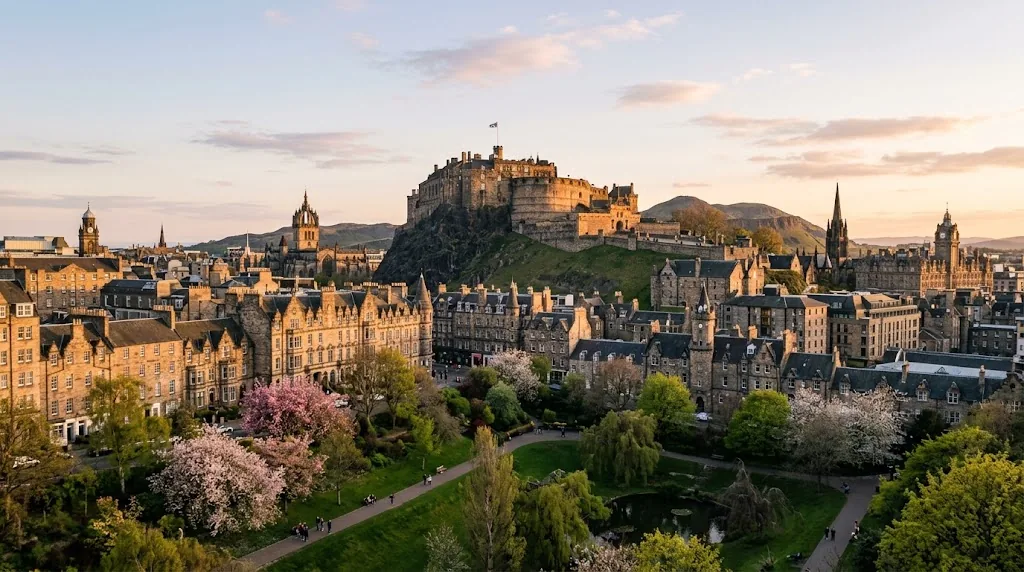
Scotland splits in two even within the cities we track. Edinburgh in April has just 11 rainy days and 1.9 in (48 mm) of rain, with a 51.4°F (10.8°C) high and 9.5 hours of sun. Glasgow, on the west side, gets 12 rainy days and 2.5 in (64 mm) in the same month. Through the year Glasgow is the wetter of the pair, with 16 rainy days in January, 17 in July and 18 in both August and December.
Summer highs are cool: Edinburgh reaches 64.8°F (18.2°C) in July and Glasgow 64.6°F (18.1°C). Those are about two degrees Fahrenheit below Dublin's July high of 66.6°F (19.2°C). July is also the month with the most rainy days in Edinburgh (16). The upside is long daylight in the north, so even a grey day gives you time for a late walk.
August brings the Edinburgh festivals, which usually run through most of the month and push accommodation prices up sharply. If you are not going for the festivals, we would avoid the city in August. In the Highlands, midges are usually a nuisance from early summer into early autumn, especially on still, damp evenings, so pack repellent for hiking in June through September. We have a more Scotland-specific breakdown in our guide to the best month to visit Scotland.
Planning one itinerary: the best time to visit Ireland and Scotland together
Most people who search for the best time to visit Ireland and Scotland are planning one trip with both countries, usually a week or two with a flight or ferry in the middle. The weather logic is simple. Ireland is milder and slightly drier in the middle of summer, Scotland is cooler and wetter in July and August, and both are at their most reliable in the same narrow window. So the question is less which country is better, and more which half of your trip gets the best days.
We would start in Ireland and finish in Scotland in May or June, so you reach the longer northern days and the Highlands when you have settled into the rhythm of wet-weather planning. In September, do it the other way round: Scotland first while the evenings are still long, then Ireland, where Cork has only 10 rainy days. In either case, leave a spare day in each country. Ferries and flights get disrupted by wind far more often than by rain, and a flexible day costs less than a missed connection.
Season by season for a combined trip
Spring
April is the driest month in Edinburgh and a decent one for Dublin (12 rainy days, 2.4 in or 61 mm). The cost is cold: April lows are 38.7°F (3.7°C) in Glasgow and 39.7°F (4.3°C) in Edinburgh, and still only 42.4°F (5.8°C) in Dublin. Daylight grows quickly through May, and by then every city has at least 10 hours of sun a day on average.
Summer
June is the safest month overall. Dublin has 14 rainy days and 11.3 hours of sun, the most sun of the four. Cork has 12 rainy days, Edinburgh 13 and Glasgow 15. July and August add a degree or two of warmth but also more rain in Scotland, so Ireland is the better pick for the middle of summer, particularly Cork, where July has 13 rainy days against 16 in Edinburgh and 17 in Glasgow.
Autumn
September is lovely when it works. Highs are 60.1°F to 62.2°F (15.6°C to 16.8°C), the summer crowds thin, and the light is soft. But October is where the cities split: Glasgow has 17 rainy days and 4.9 in (124 mm), Cork has 4.5 in (114 mm), and sun falls to 5.0 to 6.1 hours a day. We would aim for the first half of September and treat October as a weather gamble.
Winter
December is dark and wet. Glasgow has 18 rainy days, 5.1 in (130 mm) of rain, 2.6 hours of sun and 90% humidity. Edinburgh gets 2.8 hours of sun, Dublin 3.7 and Cork 3.4. The reason to go is the holiday season, lights, and in Scotland the New Year celebrations, not the scenery. Choose a city base, not a road trip, and keep an eye on the daylight.
Where we would not go, and when
- Glasgow in August or December: 18 rainy days either way. Fine for galleries and music venues, bad for anything outdoors.
- Cork in October: 4.5 in (114 mm) of rain, the wettest month of the year for the city, and only 5.6 hours of sun.
- Edinburgh in August without a festival ticket: the weather is acceptable, but you are paying peak prices for a crowded centre.
- A drive around the west coasts in January: short days and wet roads. We have no coastal data, but the city numbers (13 to 16 rainy days) make us cautious.
How to choose by goal
The best time to visit Ireland and Scotland depends on what you plan to do, so here is how we would split it up.
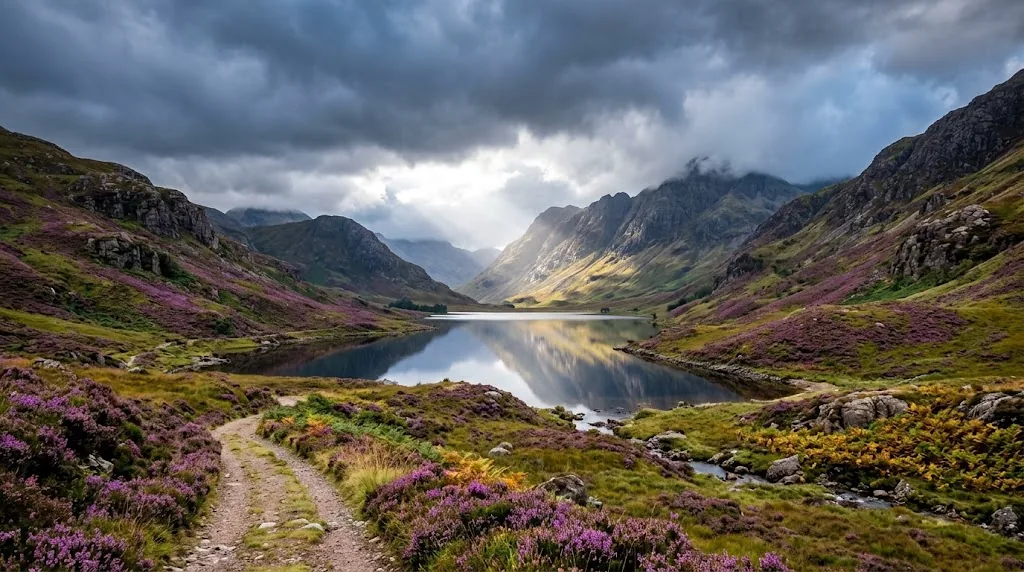
- Hiking and scenery: late May to June, or early September. Longest dry stretches and decent sun.
- Cities and culture: April in Edinburgh, May in Dublin, and anything but August in Glasgow.
- Cheapest: January to March, accepting 12 to 16 rainy days. Hotel rates are usually lower outside summer, but we do not track prices.
- Families: June, before school holidays peak in July. Cork and Dublin are the more forgiving choices in July.
- Avoiding crowds: April, early May, and September.
- Adding England: see our England guide, since London is drier than any of these cities in nearly every month.
What to pack
Waterproof jacket with a hood, not just an umbrella, since wind turns umbrellas inside out. Shoes with grip and a spare pair of socks. Layers: a fleece or wool sweater is useful in every month, even June, when lows hover around 49.6°F to 52.5°F (9.8°C to 11.4°C). In winter add a warm hat and gloves, and bring a power bank because short days mean more use of your phone for navigation. For milder weather, our guides to what to wear in 50 degree weather and 60 degree weather are close matches for most of the spring and summer highs here.
Data note: how we picked
All numbers are 20 year averages (2006 to 2025) from Open-Meteo historical data, computed by WeatherApex for the four cities named above. They describe a typical year, not a forecast, and we ranked months by rainy days, sun hours, temperature and humidity before adjusting for crowds and festivals using general knowledge. A given June can be much drier or wetter. To compare these cities with your other plans, use the trip planner. For official climate data, see Met Éireann and the Met Office.
Frequently asked questions
Is Ireland or Scotland drier in summer?
Ireland, on the city numbers. In July, Dublin has 15 rainy days and Cork 13, while Edinburgh has 16 and Glasgow 17. In August Glasgow reaches 18 rainy days and 4.8 in (122 mm) of rain, the wettest summer month in our four cities.
What is the driest month in Ireland and Scotland?
April is the driest month in Edinburgh, with 1.9 in (48 mm) and 11 rainy days. Dublin's rainfall is lowest in April too, at 2.4 in (61 mm). For rainy days alone, Cork is best in September with 10.
Is September a good time to visit Ireland and Scotland?
Yes, especially early September. Highs run 60.1°F to 62.2°F (15.6°C to 16.8°C) and Cork has only 10 rainy days. October is wetter, with Glasgow at 17 rainy days and 4.9 in (124 mm) of rain.
How cold does it get in winter?
Not extremely, but it is damp and dark. December highs are 43.5°F (6.4°C) in Glasgow, 43.9°F (6.6°C) in Edinburgh, 47.5°F (8.6°C) in Dublin and 48.4°F (9.1°C) in Cork. Sun is only 2.6 to 3.7 hours a day and Glasgow has 18 rainy days.