

Best Places to Visit in Europe, Sorted by the Season They Suit
The best places to visit in Europe change with the season: Seville in April at 73.0°F (22.8°C), Barcelona in June with 6 rainy days, Bergen in June, Lisbon in September at 77.9°F (25.5°C), and Vienna in December.
The best places to visit in Europe, on our short list, are Seville and Rome in spring, Paris and Barcelona in June, Edinburgh, Copenhagen and Bergen in high summer, Lisbon, Athens, Prague and Budapest in September, and Vienna in December. Matching the city to the month matters more than the city itself. Seville averages a lovely 73.0°F (22.8°C) in April and a punishing 97.3°F (36.3°C) in July, while Bergen gets about 98.6 inches (2,504 mm) of rain a year and is only really kind to visitors from May to June.
So rather than ranking thirteen cities from one to thirteen, we have sorted them by the season they suit. Every city here is in the WeatherApex data, and every number in this guide is a 20-year average for that city. If a place you love is missing, it is usually because we do not have the data to say anything useful about it, not because it is not worth seeing.
Best places to visit in Europe: 13 cities and their months
The number column shows the average high and rainy days in the month we would pick. Rainy days count days with measurable rain, so a rainy day in Seville and one in Bergen are very different things.
| City | Region | Best months | Our pick: high and rainy days |
|---|---|---|---|
| Seville, Spain | Southern Iberia | March, April, late October | April: 73.0°F (22.8°C), 7 days |
| Rome, Italy | Mediterranean | April, May, October | May: 73.2°F (22.9°C), 10 days |
| Amsterdam, Netherlands | North Sea coast | April, May | April: 55.9°F (13.3°C), 10 days |
| Paris, France | Western Europe | June, September | June: 72.9°F (22.7°C), 11 days |
| Barcelona, Spain | Mediterranean | May, June | June: 77.9°F (25.5°C), 6 days |
| Edinburgh, United Kingdom | Northern Britain | June to August | July: 64.8°F (18.2°C), 16 days |
| Copenhagen, Denmark | Scandinavia | June, July | July: 69.8°F (21.0°C), 13 days |
| Bergen, Norway | Norwegian fjords | May, June | June: 60.6°F (15.9°C), 14 days |
| Lisbon, Portugal | Atlantic Iberia | May, September | September: 77.9°F (25.5°C), 4 days |
| Athens, Greece | Eastern Mediterranean | May, September, October | October: 73.4°F (23.0°C), 4 days |
| Budapest, Hungary | Central Europe | September, early October | September: 72.3°F (22.4°C), 8 days |
| Prague, Czech Republic | Central Europe | May, September | September: 68.4°F (20.2°C), 9 days |
| Vienna, Austria | Central Europe | September; December for markets | December: 40.8°F (4.9°C), 9 days |

Spring: go south before it gets hot
Southern Europe has a short, golden spring, and it is the best reason to travel before the school holidays. The days are long enough for full sightseeing and the heat has not built up yet.
Seville
Seville is the hottest city on this list in summer, which is exactly why it belongs in spring. Seville in April averages 73.0°F (22.8°C) with 7 rainy days and 11.1 hours of sun, with cool nights at 53.2°F (11.8°C). March is milder at 67.8°F (19.9°C), though it is also the wettest month, with 3.2 inches (81 mm). Holy Week and the spring fair usually fall in these weeks, and the city is packed for both.
Avoid July and August unless heat is the point: both months average 97.3°F (36.3°C) and the streets empty in the afternoon. On the other hand, Seville is a good winter city, at 60.1°F (15.6°C) in January, one of the mildest city winters on the European mainland in our data.
Rome
Rome is easiest in May, when it averages 73.2°F (22.9°C) with 12.2 hours of sun. April is cooler at 66.4°F (19.1°C), and both months have 10 rainy days, usually showers that pass. The real enemy in Rome is summer heat and the crowds at the Vatican and the Colosseum. July and August both average 88.9°F (31.6°C). October is a good second window at 71.4°F (21.9°C), but November is the wettest month at 5.4 inches (137 mm), so we would not leave it later than that.
Amsterdam
Amsterdam is never warm in spring, but April is its driest month, with 1.9 inches (48 mm) of rain, 10 rainy days and a high of 55.9°F (13.3°C). That is also when the bulb fields outside the city are usually in flower, roughly from late March to early May depending on the year. Pack a proper jacket and plan for wind on the bikes. From October to December the city averages 14 rainy days a month, which is when we would go elsewhere. See Amsterdam in April.
June: the long-day sweet spot
Paris
June in Paris averages 72.9°F (22.7°C) with 11.5 hours of sun, which makes the long evenings by the river worth the price of the trip. Rain is spread through the year, so 11 rainy days in June is typical rather than bad. September is our backup at 70.3°F (21.3°C) and only 8 rainy days, the fewest of the year. We have a full breakdown in our best month to visit Paris guide. Skip December if you mind gloom: only 3.6 hours of sun a day.
Barcelona
Barcelona in June is beach weather with city energy: 77.9°F (25.5°C), 6 rainy days and 13.2 hours of sun. May is a gentler 70.2°F (21.2°C). July and August get to 82.6°F (28.1°C) and 82.4°F (28.0°C) with humidity around 72 to 74%, which feels stickier than the number suggests, and the beaches are full. September is often sold as perfect, but it has 10 rainy days in our data, the most of any month, and October has the most rain by volume at 3.6 inches (91 mm). For Barcelona, June is the month to book. More detail on Barcelona in June.
High summer: head north
When the south is baking, the best places to visit in Europe move north. None of these cities is hot, and all of them get rain in summer, but the days are very long and the mood is at its best.
Edinburgh
Edinburgh is at its warmest in July, at 64.8°F (18.2°C), and that is also the month with the most rainy days, 16. That is just how Scotland works. August is the festival month, slightly cooler at 63.5°F (17.5°C) with 14 rainy days, and the city is famously crowded and expensive then. If you want the city without the festival, go in June: 61.5°F (16.4°C) and 10.5 hours of sun. Our best month to visit Scotland guide covers the rest of the country.
Copenhagen
Copenhagen comes alive outdoors in summer, with harbour swimming spots, bikes everywhere and late light. July averages 69.8°F (21.0°C) with 12.2 hours of sun, and June has slightly more sun (12.8 hours) and fewer rainy days (11 against 13). Winter is dark, with 2.2 hours of sun in December, so we would only go then for a short Christmas break.
Bergen
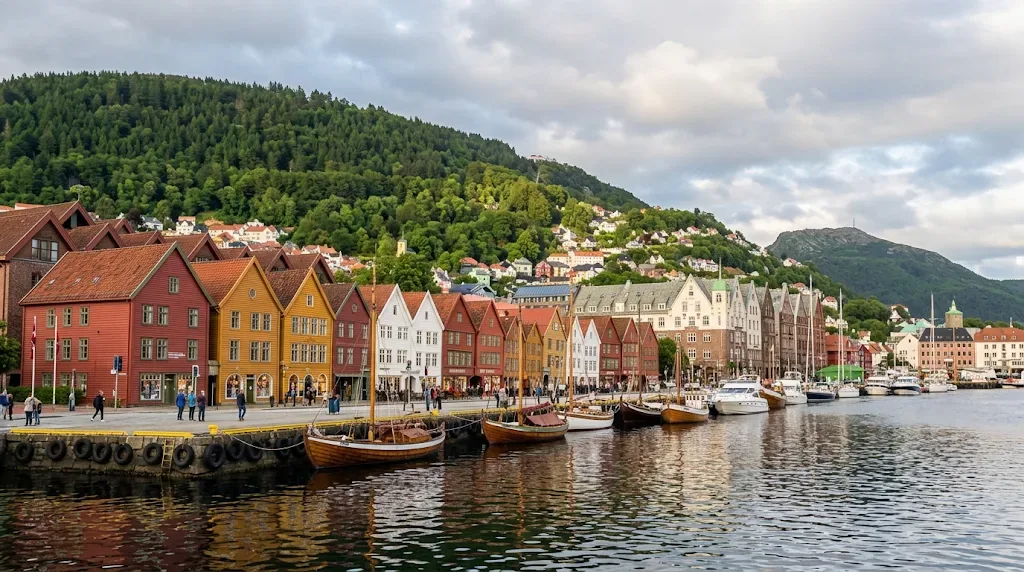
Bergen is the gateway to the western fjords and one of the wettest cities in Europe. The good news is that May and June are its driest months by rainfall, each with 4.9 inches (124 mm). June averages 60.6°F (15.9°C) with 12.1 hours of sun. Things get wetter from July, and October brings 11.9 inches (302 mm) over 20 days. If the fjords are the goal, aim for late May or June, and read our best time to visit Norway guide before booking. The Bergen in June page has the daily detail.
September: the best month for half the continent
If you can only take one European trip a year, September is the month we would choose. The sea is warm in the south, the heat has eased, and the summer crowds thin out quickly once schools go back.
Lisbon
Lisbon in September averages 77.9°F (25.5°C) with 4 rainy days and 11.1 hours of sun, about as reliable as a European city gets in autumn. May is equally dry (also 4 rainy days) and a little cooler. Our best places to visit in Portugal guide covers Porto, the Algarve and Madeira too.
Athens
Athens is too hot for comfortable sightseeing in July, at 92.1°F (33.4°C), so autumn is its moment. September averages 83.3°F (28.5°C) with 3 rainy days, and October 73.4°F (23.0°C) with 4, which we think is the best month for walking around the ancient sites. Islands are a separate question, covered in our best time to visit Greece guide.
Budapest and Prague
Central Europe has hot summers and cold winters, so the shoulder months shine. Budapest in September averages 72.3°F (22.4°C) with 8 rainy days, warm enough for the outdoor thermal baths in the evening. Prague in September is 68.4°F (20.2°C) with 9 rainy days and far fewer people on the Charles Bridge than in July. May works for both, but it is the rainiest month by days in each city, with 13, often as short afternoon thunderstorms.
Winter: one city worth the cold
Vienna
Most of the cities above are at their weakest in December, but Vienna earns a winter trip for its Christmas markets, coffee houses and concerts. December averages 40.8°F (4.9°C) by day and 31.3°F (-0.4°C) at night, with 9 rainy days, so it is cold but rarely miserable. The markets usually open in mid to late November and run until just before Christmas. For warmth instead, see where in Europe is warm in December. In summer Vienna reaches 80.4°F (26.9°C) in July, and September at 70.2°F (21.2°C) is our pick for a non-winter visit.
Where we would not go, and when
Even the best places to visit in Europe have months we would skip. These are the clearest cases in the data:
- Seville in July and August. Average highs of 97.3°F (36.3°C).
- Rome and Athens in late July and August for heavy sightseeing.
- Bergen from September to January, when every month brings 18 to 21 rainy days.
- Amsterdam, Edinburgh and Paris in December if you need daylight. Sun hours drop to 2.8 to 3.6 a day.
- Edinburgh in August on a budget, because of festival demand.
Choosing by goal
Beach and city together: Barcelona in June, Lisbon or Athens in September.
First trip to Europe: Paris and Rome in late May or June, linked by train or a short flight.
Avoiding crowds: Budapest and Prague in September, Seville in early March, Vienna in December on weekdays.
Cheaper travel: the shoulder months of April, May, September and October generally cost less than July and August, especially in the south.
Families: Copenhagen and Edinburgh in summer, when the south is too hot for small children.
Many of the best places to visit in Europe are linked by fast trains, so a two-city trip in the same season is easy to build. Our trip planner checks the weather for each stop on your dates.
What to pack
For a spring or autumn trip that crosses the continent, pack layers: a light waterproof jacket, a warm sweater, and clothes that work from the mid 50s to the high 70s Fahrenheit. Comfortable walking shoes matter more than anything else, since cobbles are everywhere. For the south in summer, bring linen, a hat and a refillable bottle. For the north in summer, a rain shell is not optional. For Vienna or Prague in December, a warm coat, hat, gloves and waterproof boots.
How we chose these cities
We picked thirteen cities from the WeatherApex data that cover Europe's main regions, from the Atlantic coast to Central Europe and Scandinavia, and gave each one the months its own numbers support. All figures are 20-year averages from 2006 to 2025. They tell you what a typical month is like, not what next week will bring, and heatwaves and storms can push any single trip well outside them. We left out places where we do not have data rather than guess, which is why this list of the best places to visit in Europe has no Alpine resorts or Croatian coast.
One practical last point: in summer, book trains and central hotels early for the southern cities, and keep a flexible indoor plan for the northern ones. A rainy afternoon in Bergen or Edinburgh is almost guaranteed.
Frequently asked questions
What is the best month to travel around Europe?
September suits the most cities in our data. Lisbon averages 77.9°F (25.5°C) with 4 rainy days, Athens 83.3°F (28.5°C) with 3, and Budapest 72.3°F (22.4°C) with 8. Crowds also drop once the school holidays end.
Which European cities are best in summer?
The northern ones. Copenhagen averages 69.8°F (21.0°C) in July and Edinburgh 64.8°F (18.2°C), while Seville reaches 97.3°F (36.3°C) and Athens 92.1°F (33.4°C). Expect rain in the north, though: Edinburgh has 16 rainy days in July.
Where in Europe is good to visit in spring?
Seville and Rome are our spring picks. Seville averages 73.0°F (22.8°C) in April with 7 rainy days, and Rome 73.2°F (22.9°C) in May with 12.2 hours of sun. Amsterdam is cooler at 55.9°F (13.3°C) in April, but it is the city's driest month.
Is Europe worth visiting in December?
Yes for Christmas markets and city breaks. Vienna averages 40.8°F (4.9°C) by day and 31.3°F (-0.4°C) at night with 9 rainy days. Daylight is short in the north, with 2.2 hours of sun a day in Copenhagen, so for warmth head south to Seville, at 61.3°F (16.3°C).