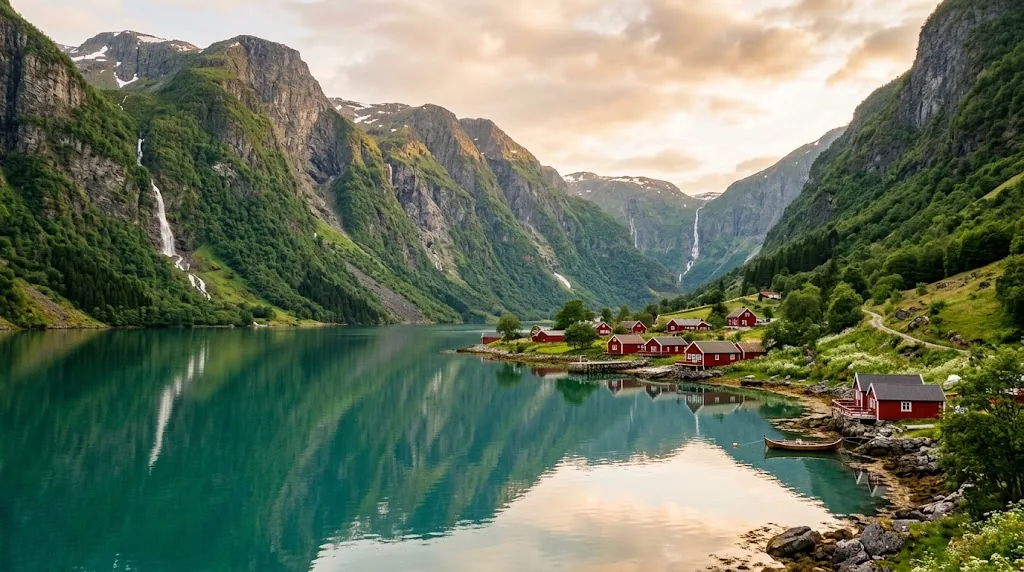
Best Time to Visit Norway: Month-by-Month Weather and Daylight
June is the best time to visit Norway for most trips: Oslo averages 68.0°F (20.0°C) with 13.3 hours of sun, while Bergen gets about 98.6 inches of rain a year. Winter brings 1.0 to 2.0 hours of sun a day in December.
The best time to visit Norway for most trips is June, and the long summer stretch from late May to early September is the sensible window for fjords, hiking and city sightseeing. In June, Oslo averages 68.0°F (20.0°C) with 13.3 hours of sun a day, Trondheim 61.3°F (16.3°C) with 11.7, and Bergen 60.6°F (15.9°C) with 12.1. Winter is a separate trip, with a different purpose, and we cover it further down.
Norway is long and thin, and our numbers cover three cities in the south and centre: Oslo, Bergen and Trondheim. They are WeatherApex 20-year averages (2006 to 2025). The midnight sun and the northern lights happen mostly north of these cities, in Arctic Norway, where we have no data, so we describe those two only in general terms.
Best time to visit Norway: Oslo, Bergen and Trondheim across four seasons
The table picks one representative month for each season. Highs and lows are daily averages, and rainy days count days with measurable rain.
| Place | Month | Avg high | Avg low | Rain | Rainy days | Sun (hrs/day) |
|---|---|---|---|---|---|---|
| Oslo | February | 31.8°F (-0.1°C) | 21.7°F (-5.7°C) | 2.3 in (58 mm) | 10 | 4.4 |
| Oslo | June | 68.0°F (20.0°C) | 52.5°F (11.4°C) | 3.7 in (94 mm) | 12 | 13.3 |
| Oslo | September | 60.6°F (15.9°C) | 49.5°F (9.7°C) | 3.6 in (91 mm) | 11 | 7.7 |
| Oslo | December | 32.4°F (0.2°C) | 24.6°F (-4.1°C) | 2.8 in (71 mm) | 12 | 2.0 |
| Bergen | February | 37.4°F (3.0°C) | 28.9°F (-1.7°C) | 7.9 in (201 mm) | 17 | 3.9 |
| Bergen | June | 60.6°F (15.9°C) | 48.6°F (9.2°C) | 4.9 in (124 mm) | 14 | 12.1 |
| Bergen | September | 58.3°F (14.6°C) | 48.4°F (9.1°C) | 10.3 in (262 mm) | 18 | 7.1 |
| Bergen | December | 38.1°F (3.4°C) | 31.1°F (-0.5°C) | 11.4 in (290 mm) | 21 | 1.6 |
| Trondheim | February | 32.7°F (0.4°C) | 22.8°F (-5.1°C) | 3.3 in (84 mm) | 14 | 4.2 |
| Trondheim | June | 61.3°F (16.3°C) | 47.8°F (8.8°C) | 3.8 in (97 mm) | 16 | 11.7 |
| Trondheim | September | 57.9°F (14.4°C) | 46.6°F (8.1°C) | 4.9 in (124 mm) | 16 | 7.5 |
| Trondheim | December | 32.5°F (0.3°C) | 23.7°F (-4.6°C) | 4.0 in (102 mm) | 16 | 1.0 |
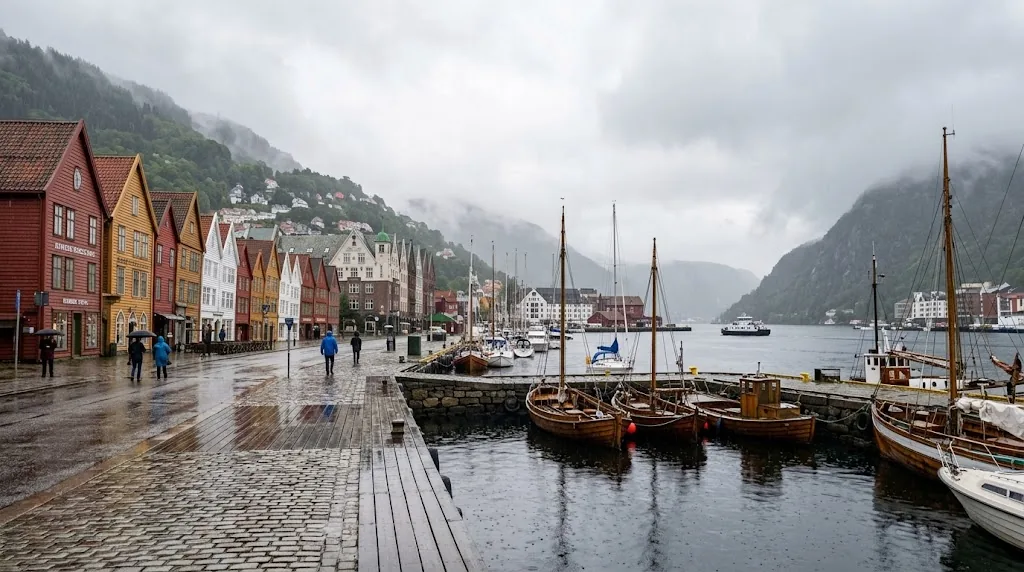
The first thing to notice is Bergen. It is the mildest city in winter (36.0°F, or 2.2°C, in January) and the wettest all year, with about 98.6 inches (2,504 mm) of rain across 12 months, against 38.7 inches (983 mm) in Oslo and 46.3 inches (1,176 mm) in Trondheim. Plan Bergen with a raincoat in mind, whatever the month.
June to August: the main season, with some conditions
June is our favourite. Oslo has 12 rainy days and 3.7 inches (94 mm), which is the lowest rain total of its summer months, and the evenings stay light very late. Oslo in June is the month to pick if you want a city break with a swim in the fjord.
July is the warmest month, at 70.9°F (21.6°C) in Oslo, 66.2°F (19.0°C) in Trondheim and 64.0°F (17.8°C) in Bergen, but it is also wetter. Oslo has 14 rainy days and 4.7 inches (119 mm), Trondheim 16 rainy days, and Bergen jumps to 18 rainy days and 6.8 inches (173 mm). August is wetter again in Bergen, with 19 rainy days and 8.6 inches (218 mm), and Oslo sees 15 rainy days in the same month. Norwegians usually take their main holiday in July, so the coast and the popular hiking routes are busy.
Summer in the north of the country brings the midnight sun, when the sun does not set at all above the Arctic Circle. It usually lasts from about late May to late July, depending on how far north you are. Our three cities do not get that, though they have very long days: Oslo's average of 13.3 sun hours in June is the highest figure of its year.
Late spring: May is quieter than you would think
May is a smart shoulder month. Oslo is 60.6°F (15.9°C), with 11.9 hours of sun, and Trondheim is 55.4°F (13.0°C) with 11.7. Bergen in May is 55.4°F (13.0°C), with 14 rainy days and 4.9 inches (124 mm). That is one of the two driest months of the year there, alongside June. Waterfalls are usually at their fullest in late spring and early summer because of snowmelt, and you avoid the July queues. The catch is that some high mountain roads and seasonal ferry routes only reopen in late May or June, so check the dates for the route you want.
September to November: pretty, then dark and wet
September is still usable in Oslo (60.6°F or 15.9°C, 11 rainy days, 7.7 hours of sun), and the forest colours usually turn in late September and October. But the sun hours drop quickly. By October Oslo has 4.7 hours a day and 49.1°F (9.5°C). By November it has 2.5 hours and 39.7°F (4.3°C).
Bergen is where autumn really hurts. September brings 10.3 inches (262 mm) over 18 rainy days, October is its wettest month at 11.9 inches (302 mm) over 20 rainy days, and November has 10.3 inches (262 mm) again. We would not book a scenic trip to Bergen between September and December. Trondheim is less extreme but still grey, with 16 rainy days in September and 18 in October.
December to March: for snow, skiing and the aurora
Oslo in January averages 29.5°F (-1.4°C) for a high and 20.7°F (-6.3°C) for a low, and in February 31.8°F (-0.1°C). Sun hours are 2.6 and 4.4 a day. March is 40.1°F (4.5°C) with 7.4 hours of sun, which is why many people consider late February and March the best part of the cold season: you get snow and daylight together. Trondheim in December has only 1.0 hour of sun a day on average, and Bergen has 1.6 hours with 21 rainy days. Those are the darkest numbers of the three cities.
The northern lights belong to the dark half of the year, roughly late September to March, and need clear skies and a long way north, in places like Tromsø, the Lofoten islands or the Alta area. None of those are in our data, so we cannot give you numbers on cloud cover. Oslo, Bergen and Trondheim are poor places to plan an aurora trip around. For a comparison with another northern destination, our best time to visit Iceland guide covers the same trade-off.

The best time to visit Norway for a classic Oslo and Bergen route
Many first trips link Oslo and Bergen, by train over the mountains or with a fjord detour in between. For that route we would go in the first half of June. Oslo has 12 rainy days and 13.3 hours of sun, and Bergen has 14 rainy days and 12.1 hours, with 4.9 inches (124 mm) of rain. By July Bergen has 18 rainy days and 6.8 inches (173 mm), and by August 19 rainy days and 8.6 inches (218 mm), so each week you wait adds a little more wet weather to the coast.
If June does not fit, late August into early September is the second option for Oslo, but not for Bergen. Oslo drops from 15 rainy days in August to 11 in September, while Bergen stays at 18 to 19 rainy days and its rain still climbs, from 8.6 to 10.3 inches. The advice that follows is to spend more of your time on the Oslo and Trondheim side of the map in September and to shorten Bergen to a day or two.
Why daylight changes the plan
In midsummer, the light lets you hike late, take a ferry after dinner and still reach your hotel before it is truly dark. In midwinter the same itinerary shrinks. A day in Trondheim in December has an average of 1.0 hour of sun, so you plan indoor sights for the middle of the day and keep outdoor time short. This is the main reason we recommend summer for first-time visitors and treat winter as a specific trip for skiers, aurora hunters and people who like cold, dark cities.
Where we would not go, and when
- Bergen from September to January. Rainy-day counts range from 18 to 21, and 9.3 to 11.9 inches (236 to 302 mm) of rain a month.
- Oslo in November and December, unless you are going for Christmas markets. Highs are 39.7°F (4.3°C) and 32.4°F (0.2°C), with 2.5 and 2.0 hours of sun.
- Trondheim in December and January. Sun is 1.0 and 1.9 hours a day, with 16 rainy days in each.
- High mountain hikes before July. Snow often remains on higher trails into early summer, so check local trail reports.
Choosing by what you want from the trip
- Fjords and hiking: June, with a second chance in early September in Oslo and Trondheim. Bergen is best in May and June.
- City sightseeing: June and early September. See Trondheim in July for the warmest month there, with 11.7 hours of sun.
- Lower costs: Norway is expensive in every season. May and September are the least bad, because accommodation is less pressured than in July.
- Families: late June and July, when the days are longest and the school holiday is on, although you need rain gear for Bergen.
- Avoiding crowds: May, early June and the first half of September.
- Skiing and snow: February and March, as above, which is also the best time to visit Norway if you want winter without the deepest darkness. For a comparison with another snowy destination, read our best time to visit Alaska guide.
Sun hours by month
This is the number that shapes a Norwegian trip more than temperature. The spread between summer and winter is dramatic, especially in Trondheim.
| Month | Oslo | Bergen | Trondheim |
|---|---|---|---|
| January | 2.6 | 2.2 | 1.9 |
| February | 4.4 | 3.9 | 4.2 |
| March | 7.4 | 6.1 | 6.8 |
| April | 10.2 | 9.7 | 9.6 |
| May | 11.9 | 11.6 | 11.7 |
| June | 13.3 | 12.1 | 11.7 |
| July | 12.3 | 11.0 | 11.7 |
| August | 10.2 | 9.5 | 10.0 |
| September | 7.7 | 7.1 | 7.5 |
| October | 4.7 | 4.8 | 4.8 |
| November | 2.5 | 2.9 | 2.6 |
| December | 2.0 | 1.6 | 1.0 |
Oslo hits 13.3 hours in June, while Trondheim stays around 11.7 hours from May to July. In December the three cities collect 2.0, 1.6 and 1.0 hours a day. The practical lesson is to plan winter days around a short daylight window.
What to pack for Norway
A waterproof jacket is non-negotiable, particularly for Bergen. Summer lows are cooler than the highs suggest: Oslo averages 52.5°F (11.4°C) at night in June and Bergen 52.9°F (11.6°C) in July, so bring a fleece or a light insulated layer for evenings on the water. In winter, Oslo's January low of 20.7°F (-6.3°C) calls for thermal layers, a warm hat and shoes with grip. Our guides to what to wear in 40-degree weather and 50-degree weather match the spring and autumn range.
How we picked these months
To settle on the best time to visit Norway, we looked at comfort, rainy days and hours of sun for each month in the three cities, then added what is generally known about seasonal road openings, holiday timing and aurora season. The averages use Open-Meteo Historical Weather API data for 2006 to 2025. They show typical conditions, not a forecast for a specific week, and rain in Bergen in particular varies a lot from year to year. When you have a date range in mind, the trip planner will help you compare it. Finally, book fjord ferries and mountain accommodation before you finalize flights, because they are the limited resources and tend to sell out first.
Frequently asked questions
What is the best month to visit Norway?
June is our pick for most trips. Oslo averages 68.0°F (20.0°C) with 13.3 hours of sun a day, Trondheim 61.3°F (16.3°C), and Bergen 60.6°F (15.9°C). May is a good quieter alternative, particularly for Bergen, which has 4.9 inches (124 mm) of rain that month.
When is the rainiest time in Bergen?
Autumn and early winter. October is the wettest month, at 11.9 inches (302 mm) over 20 rainy days, and December has 21 rainy days and only 1.6 hours of sun a day. May and June are the driest months, at 4.9 inches (124 mm) each.
How cold is Norway in winter?
Oslo averages a high of 29.5°F (-1.4°C) and a low of 20.7°F (-6.3°C) in January. Bergen is milder at 36.0°F (2.2°C) but much wetter. Trondheim is similar to Oslo, at 30.9°F (-0.6°C) in January, with only 1.9 hours of sun a day.
When can you see the northern lights and the midnight sun in Norway?
The northern lights are usually seen from about late September to March, and mostly in the far north, where our data does not reach. The midnight sun usually runs from about late May to late July above the Arctic Circle. None of our three cities gets the midnight sun, and the aurora is far more reliable further north.