Best Time to Visit Kenya: Safari Seasons, Rains and the Migration
The best time to visit Kenya for safari is late June to October, when Nairobi gets only 0.7 to 1.1 inches of rain a month. April is the wettest month, with 5.7 inches over 22 days.
The best time to visit Kenya for a safari is the long dry season, from late June to October. In Nairobi, July averages just 0.7 inches (17 mm) of rain over 4 days, and August and September only about 1.1 inches (27 to 28 mm) over 6 days each. This is also the season of the Great Migration in the Maasai Mara. A second, shorter dry window runs from January to February, which is warmer and quieter but less dramatic for wildlife.
Kenya does not have summer and winter in the way most travelers expect. Sitting on the equator, it has two dry seasons and two rainy seasons instead. The "long rains" usually fall from March to May and the "short rains" around October to December. Pick your dates around those, and around what you want to see, and the rest falls into place.
Best time to visit Kenya: Nairobi weather by month
The table below shows WeatherApex 20-year averages (2006 to 2025) for Nairobi, the capital and the starting point for most safaris. Nairobi sits at roughly 1,800 meters above sea level, which is why it is cooler than many people expect. The safari parks in the south, such as the Maasai Mara and Amboseli, broadly follow the same rainy seasons. The coast is hotter and more humid, and we cover it in general terms further down.
| Month | Avg high F (C) | Avg low F (C) | Rain (in / mm) | Rainy days | Sun hours per day | Humidity |
|---|---|---|---|---|---|---|
| January | 79.0 (26.1) | 58.1 (14.5) | 1.4 / 35 | 7 | 11.4 | 63% |
| February | 81.0 (27.2) | 59.0 (15.0) | 1.6 / 40 | 6 | 11.4 | 59% |
| March | 80.6 (27.0) | 59.9 (15.5) | 2.8 / 71 | 12 | 11.0 | 63% |
| April | 76.6 (24.8) | 60.4 (15.8) | 5.7 / 146 | 22 | 10.2 | 76% |
| May | 74.7 (23.7) | 58.8 (14.9) | 3.5 / 90 | 16 | 10.4 | 75% |
| June | 73.4 (23.0) | 56.1 (13.4) | 1.4 / 36 | 8 | 9.5 | 71% |
| July | 72.5 (22.5) | 54.5 (12.5) | 0.7 / 17 | 4 | 8.4 | 68% |
| August | 73.2 (22.9) | 54.9 (12.7) | 1.1 / 28 | 6 | 8.5 | 68% |
| September | 76.8 (24.9) | 55.9 (13.3) | 1.1 / 27 | 6 | 10.2 | 64% |
| October | 78.3 (25.7) | 58.5 (14.7) | 2.7 / 70 | 12 | 10.7 | 65% |
| November | 75.0 (23.9) | 59.0 (15.0) | 4.4 / 112 | 20 | 10.3 | 77% |
| December | 76.1 (24.5) | 58.5 (14.7) | 2.7 / 68 | 14 | 10.9 | 73% |
Three patterns stand out. April is by far the wettest month, at 5.7 inches (146 mm) over 22 days. November is the second peak, at 4.4 inches (112 mm) over 20 days. And the driest months, July to September, are also the coolest and the cloudiest: July averages only 72.5F (22.5C) by day, 54.5F (12.5C) at night, and 8.4 hours of sun. That is the classic Nairobi "winter": dry, grey mornings that clear by afternoon.
Kenya through the year
January and February: the short dry season
This is the warmest and sunniest time of the year in Nairobi. February averages 81.0F (27.2C), the highest of the year, with only 1.6 inches (40 mm) of rain over 6 days and 11.4 hours of sunshine a day. Humidity is at its lowest, at 59%.
For a safari, it is a very good second choice. The grass is shorter after the short rains, animals are easier to spot, and across the border in Tanzania the wildebeest herds are usually calving in the southern Serengeti. It is also a great time to combine a safari with a beach week on the coast. See Nairobi weather in February for the details.
March to May: the long rains
The rains build through March (2.8 inches, 12 rainy days) and peak in April at 5.7 inches (146 mm) over 22 days. May eases to 3.5 inches (90 mm) over 16 days. Humidity climbs to 75% to 76%, and dirt roads in the parks can turn muddy.
This is low season, and it is the period we would avoid for a first safari. Some smaller camps close for part of it, and game drives can be cut short by heavy storms. On the upside, prices fall sharply, the landscape is lush and green, and the parks are almost empty. Experienced travelers who do not mind getting wet sometimes love it. The April weather page shows how wet it gets.
June to October: the long dry season and the migration
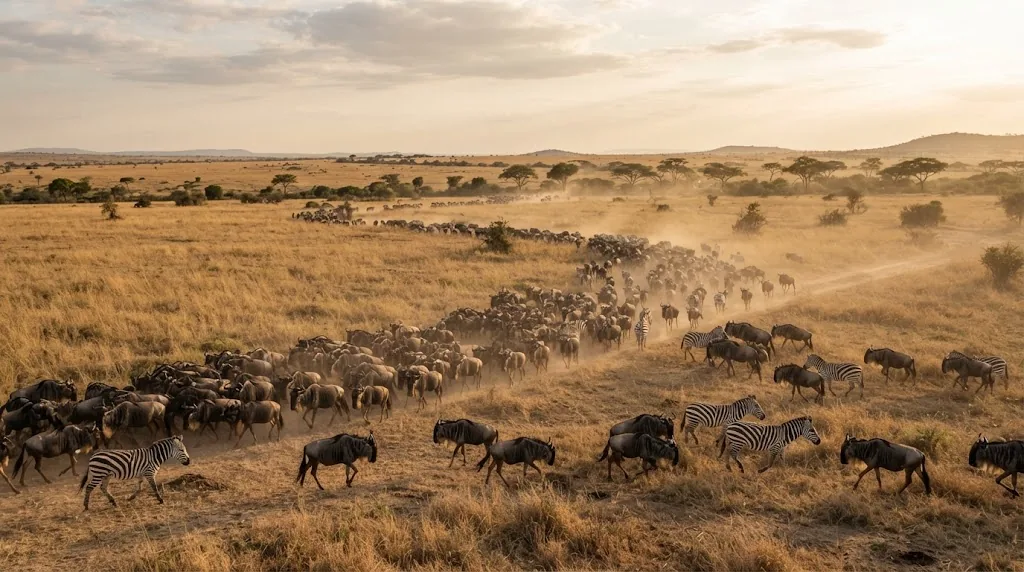
June is the turning point: rain falls back to 1.4 inches (36 mm) over 8 days. From July to September, Nairobi gets only 0.7 to 1.1 inches a month and 4 to 6 rainy days. This is peak safari season. Vegetation thins out, animals gather around rivers and waterholes, and the Great Migration of wildebeest and zebra usually reaches the Maasai Mara in July or August, with the dramatic river crossings often peaking in August and September.
The trade-off is cooler weather and crowds. Mornings on game drives can be cold, especially in an open vehicle at dawn, and nights in the highlands drop to around 54F to 56F (12C to 13C). Popular camps book out many months ahead, and prices are at their highest. Full numbers are on the August in Nairobi page.
October is a shoulder month. It is warmer at 78.3F (25.7C), but rain picks up to 2.7 inches (70 mm) over 12 days as the short rains approach. The migration often lingers into early October, and crowds start to thin.
November and December: the short rains
November is the heart of the short rains, with 4.4 inches (112 mm) over 20 days and 77% humidity. The rain tends to fall in afternoon showers rather than all-day downpours, so mornings are often clear for game drives. December dries out to 2.7 inches (68 mm) over 14 days, and the Christmas holidays bring a spike in demand. See November in Nairobi for that month.

The Kenyan coast follows a different rhythm
Mombasa, Diani, Watamu and Lamu are hot and humid all year, much warmer than Nairobi at night. The coast also has its own wet season, usually heaviest around April to June, when some beach hotels close. The calmest and most reliable beach months are usually December to March, which is why many people pair a February safari with a week on the Indian Ocean. We do not yet have coast figures on WeatherApex, so treat this as the general pattern rather than hard numbers.
How to choose your month
- The Great Migration: late July to September in the Maasai Mara. This is the best time to visit Kenya if the river crossings are your goal.
- Best safari weather overall: July to September for dry roads and easy game viewing.
- Warm, sunny and quieter: January and February. A great choice for safari plus beach trips.
- Lowest prices: April and May, if you can accept the long rains and some camp closures.
- Bird watching: November to April, when migrant birds arrive and the landscape is green.
- Climbing or hiking: the dry months, January to February and late June to September, give the most reliable trail conditions on Mount Kenya.
- Families on school holidays: July and August work well, though prices are high. Book a year ahead for the best camps.
If you are also considering southern Africa, the seasons there run differently. Our best time to visit South Africa guide explains how the safari and Cape Town seasons line up.
The best time to visit Kenya, park by park
The country's main parks share the same two rainy seasons, but each has its own reasons to pick a particular month.
Maasai Mara: July to October for the migration, with August and September usually the best chance of river crossings. January and February are quieter, with good resident wildlife and big cats, and far fewer vehicles at each sighting.
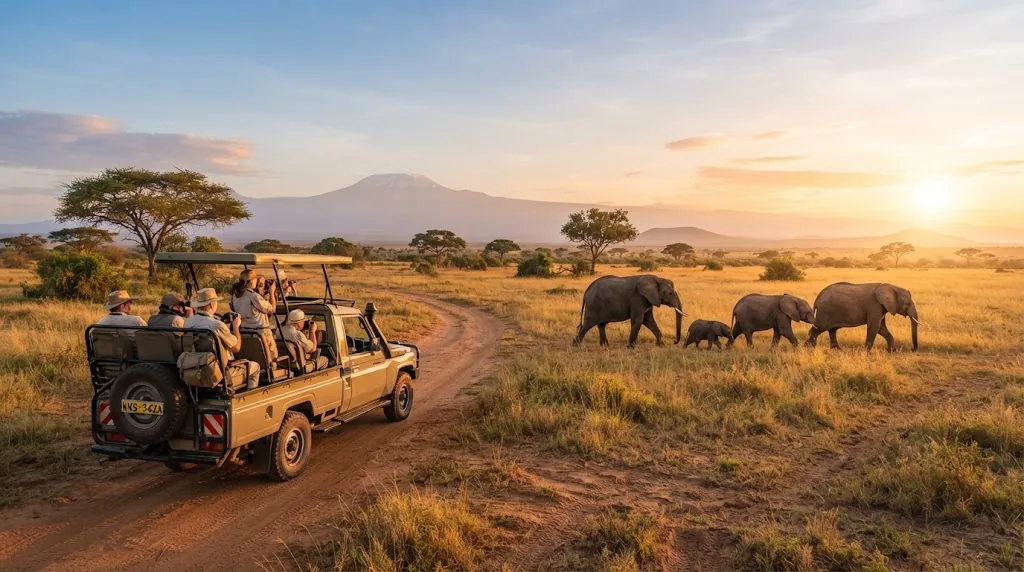
Amboseli: the dry months are best, both for game viewing and for views of Kilimanjaro across the border. Clear mornings are more common in the dry season, and the mountain is often hidden by cloud later in the day. Large elephant herds are a highlight here all year.
Samburu and the north: this region is drier and hotter than the south, so it is often good even when the Mara is wet. It is home to species you will not see further south, such as the reticulated giraffe and Grevy's zebra.
Lakes Nakuru and Naivasha: easy to visit from Nairobi at any time, and good for a short stop. Birding is especially rewarding from November to April.
Put simply, the best time to visit Kenya for a classic multi-park safari is late June to early October. If you would rather trade the migration for space and lower prices, January and February are the next best time to visit Kenya, especially for a first trip that ends on the coast.
Is it cold in Kenya?
Many first-time visitors pack only for the heat and then shiver on morning game drives. Nairobi's coolest months, July and August, average lows of 54.5F and 54.9F (12.5C and 12.7C). The parks at higher altitude can be colder at dawn. Daytime highs are mild at about 72F to 73F (22C to 23C) in those months. In other words, the "cold season" in Kenya feels like a pleasant spring day by noon and like a cool autumn evening after dark. Our what to wear in 50 degree weather guide covers early morning drives well.
What to pack for a Kenya trip
- Safari, any month: neutral colored, breathable layers (khaki, olive, beige), a warm fleece or jacket for dawn drives, a wide-brimmed hat, sunglasses and good binoculars.
- Rainy seasons: a light waterproof jacket and quick-drying clothes. The rain usually comes in bursts, so you will still be out on drives.
- Coast: light cotton and linen, swimwear, strong sunscreen and insect repellent.
- Health and practical: check current health advice for travelers well before you go, and pack soft bags if you are taking small planes between parks, since luggage limits are strict.
Where our numbers come from
All figures here come from WeatherApex climate data for Nairobi: daily weather from 2006 to 2025, averaged by month. We focused on rain, rainy days and sunshine, since temperatures are mild year-round. Nairobi is a good guide to the rainy seasons in the main safari areas, but the coast and the dry north have their own patterns. These are typical conditions, not a forecast, and the start of each rainy season can shift by a few weeks. See Nairobi weather by month for every month, or compare dates in the trip planner. For official forecasts and seasonal outlooks, see the Kenya Meteorological Department.
One planning note: migration timing changes with the rains each year. If the river crossings are the reason for your trip, plan at least four or five days in the Mara to give yourself a fair chance of seeing one.
Frequently asked questions
What is the best month to go on safari in Kenya?
August is a strong choice. Nairobi averages 1.1 inches (28 mm) of rain over 6 days, and the Great Migration is usually in the Maasai Mara, with river crossings often peaking in August and September. July is the driest month at 0.7 inches (17 mm).
When are the rainy seasons in Kenya?
Kenya has two. The long rains usually run from March to May, peaking in April at 5.7 inches (146 mm) over 22 days in Nairobi. The short rains come around October to December, peaking in November at 4.4 inches (112 mm).
Is Kenya cold in July?
Nairobi is cool, not cold. July averages a high of 72.5F (22.5C) and a low of 54.5F (12.5C), with 8.4 hours of sun. Early morning game drives can feel chilly, so pack a warm layer.
Is January a good time to visit Kenya?
Yes. January and February form a short dry season. Nairobi averages 79F to 81F (26C to 27C), 6 to 7 rainy days and 11.4 hours of sun. It is quieter than July and August and pairs well with a beach week on the coast.