Best Time to Visit Mexico City: Dry Season, Rainy Season and Altitude
The best time to visit Mexico City is February to April, when it averages 73.9F to 79.5F (23.3C to 26.4C) with only 3 to 8 rainy days. July and August bring 25 rainy days a month and about 8 inches (206 mm) of rain.
The best time to visit Mexico City is February to April, with November and early December as a close second. Those months are dry and sunny: February averages 73.9F (23.3C) with 3 rainy days and 10.7 hours of sun, March 77.4F (25.2C) with 6 rainy days, and November 70.5F (21.4C) with 6 rainy days and 1.1 inches (28 mm) of rain. The main thing to avoid is July to September, when it rains on 22 to 25 days a month.
The city sits at roughly 2,240 meters (7,350 feet) in a high valley, and that explains most of what the numbers show. Days are mild all year, nights are cool, and the rain follows a clear seasonal pattern instead of arriving at random. All the figures below are 20-year averages (2006 to 2025) for Mexico City itself.
Best Time to Visit Mexico City: The Full Year in One Table
Read the table for two patterns. Temperature barely moves: the average high stays between 70.0F (21.1C) and 79.5F (26.4C) in every month. Rain does all the moving. Rainy days go from 3 in February and December to 25 in July and August.
| Month | Mexico City high | Mexico City low | Mexico City rain | Mexico City rainy days | Mexico City sun hrs/day | Mexico City humidity |
|---|---|---|---|---|---|---|
| January | 70.0F (21.1C) | 45.0F (7.2C) | 0.7 in / 18 mm | 4 | 10.1 | 57% |
| February | 73.9F (23.3C) | 46.8F (8.2C) | 0.7 in / 18 mm | 3 | 10.7 | 51% |
| March | 77.4F (25.2C) | 49.6F (9.8C) | 1.1 in / 28 mm | 6 | 11.2 | 47% |
| April | 79.5F (26.4C) | 52.7F (11.5C) | 1.5 in / 38 mm | 8 | 11.8 | 46% |
| May | 79.0F (26.1C) | 54.9F (12.7C) | 2.9 in / 74 mm | 13 | 11.8 | 55% |
| June | 74.8F (23.8C) | 55.6F (13.1C) | 6.5 in / 165 mm | 19 | 10.6 | 68% |
| July | 71.2F (21.8C) | 54.3F (12.4C) | 8.2 in / 208 mm | 25 | 10.2 | 77% |
| August | 71.6F (22.0C) | 54.7F (12.6C) | 8.1 in / 206 mm | 25 | 10.2 | 78% |
| September | 70.3F (21.3C) | 54.3F (12.4C) | 8.1 in / 206 mm | 22 | 9.4 | 79% |
| October | 70.5F (21.4C) | 51.4F (10.8C) | 3.3 in / 84 mm | 13 | 9.8 | 74% |
| November | 70.5F (21.4C) | 48.0F (8.9C) | 1.1 in / 28 mm | 6 | 10.1 | 66% |
| December | 70.2F (21.2C) | 46.0F (7.8C) | 0.5 in / 13 mm | 3 | 10.4 | 60% |
Best Time to Visit Mexico City: The Quick Answer
People expect "Mexico" to mean heat, and it does not apply here. The hottest month on average is April, at 79.5F (26.4C). Even then the low is 52.7F (11.5C), so evenings feel fresh and a light jacket is useful. In December and January the overnight low is 46.0F and 45.0F (7.8C and 7.2C), and many older buildings are not heated, so a cold bedroom is a real possibility.
Altitude also affects you physically. Many visitors notice shortness of breath on the stairs, a mild headache or poor sleep in the first day or two. Drink water, go easy on alcohol the first night and do not schedule a long hike on arrival day. The sun is strong too, because the air is thin: with 11.8 hours of sun a day in April and May, sunscreen and a hat matter more than the 79F figure suggests.
The dry season, November to April: our pick for most trips
From November through April, rain is light and mostly a non-event. November has 6 rainy days and 1.1 inches (28 mm). December is the driest month of the year at 0.5 inches (13 mm) and 3 rainy days. January in Mexico City adds a bit more at 0.7 inches (18 mm) over 4 days, with 10.1 hours of sun. February is the sweet spot: 73.9F (23.3C), 3 rainy days, 10.7 sun hours and humidity of just 51%.
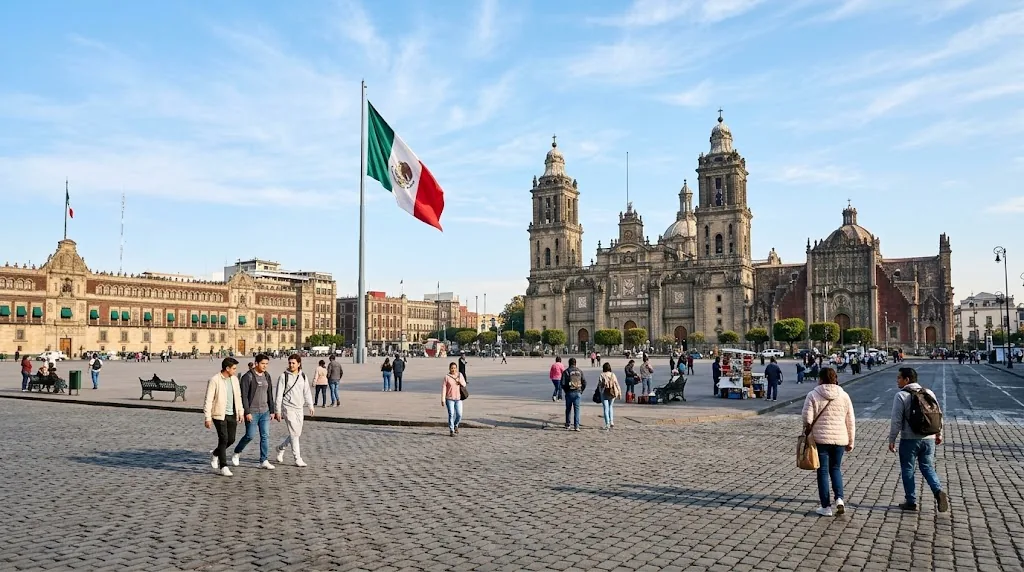
March and April are warmer still and still mostly dry (6 and 8 rainy days). They are great for walking the historic center, the Chapultepec park and the neighborhoods like Roma and Condesa. Two catches. Easter week (Semana Santa) usually brings domestic travelers and higher prices, and the dry spring months are when haze from air pollution is generally worst. If you have asthma or sensitive lungs, plan for that and check the daily air quality reading before a big outdoor day.
Our recommendation for first-timers is late February or early March. You get 73.9F to 77.4F (23.3C to 25.2C), clear mornings and the museums, markets and street food without wet-weather detours. February in Mexico City is the cleanest single month in the dataset.
May and June: the turning point
May is the month people misjudge. It is still the second warmest at 79.0F (26.1C) with 11.8 hours of sun, but rain has returned: 2.9 inches (74 mm) over 13 rainy days and humidity up to 55%. The storms usually build in the late afternoon. By June the shift is complete, with 6.5 inches (165 mm), 19 rainy days and a lower 74.8F (23.8C) high. If you are choosing the best time to visit Mexico City on a tight budget and can live with a few storms, early May sits right on the edge of the good weather and the lower prices.
November and December: the cultural highlights
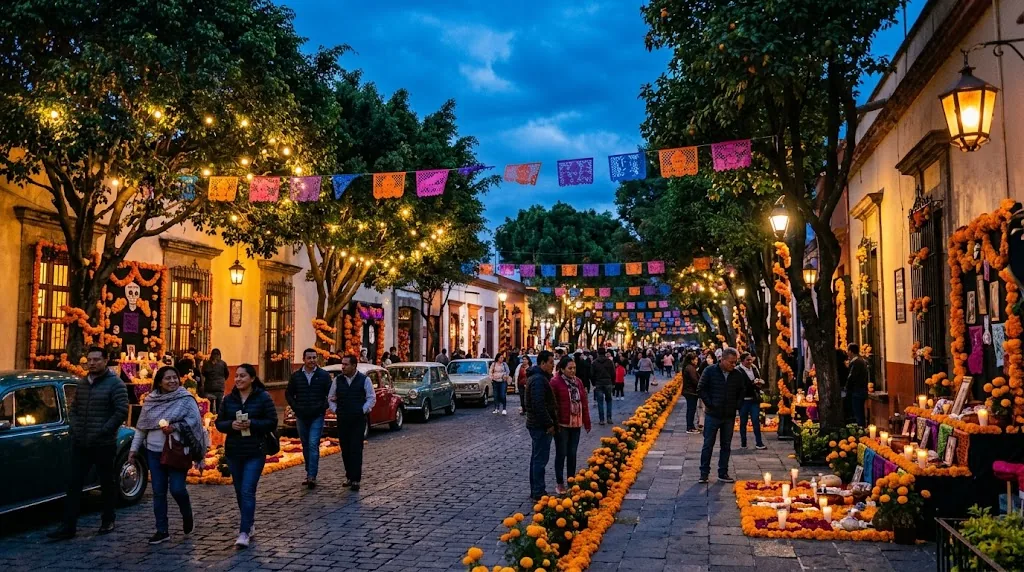
November is the month that gives the dry season a second wind. Highs are steady at 70.5F (21.4C), the lows are 48.0F (8.9C), and the rain has finally stopped. Day of the Dead (Dia de Muertos), observed on November 1 and 2, is the reason many people come, with altars, marigolds and processions through the city. Expect higher hotel prices and big crowds around those dates, and book early.
December has the lowest weather risk of the year, with 3 rainy days and 10.4 sun hours, and a festive atmosphere through the holidays. The cost is price: the last week of December and the first days of January are expensive and busy. Early December is the sweet spot, before the holiday travel starts.

The rainy season: not a write-off
The wet months run from about June to September, with October as a transition. Here is what the data says. June has 6.5 inches (165 mm) over 19 rainy days. July and August are the peak at 8.2 and 8.1 inches (208 and 206 mm), each with 25 rainy days, and September has 8.1 inches (206 mm) over 22 days. Humidity climbs to 77% to 79%, and sun hours drop to 9.4 to 10.2 a day.
That sounds grim, but the pattern matters. In the rainy season, rain usually comes as an afternoon or early-evening downpour, sometimes with thunder, and mornings are often bright. Highs stay at a cool 70.3F to 71.6F (21.3C to 22.0C), which is a comfortable temperature to walk in. The city is greener, the museums are less crowded and hotel prices tend to be lower. If you plan your outdoor sightseeing before 2 pm and keep the afternoon for a museum or a long lunch, you can have a good trip in July.
The real problems are practical: flooded streets, slow traffic, and the occasional cancelled plan. Bring a compact umbrella and shoes that cope with wet pavement. August in Mexico City is the wettest month, so it is the one we would skip if you have a choice and a fixed itinerary of outdoor sights.
October is the shoulder month. Rain falls to 3.3 inches (84 mm) over 13 rainy days, the high is 70.5F (21.4C) and sun is back to 9.8 hours. It is wetter than November but a good option if you want slightly lower prices before Day of the Dead.
Which month for which goal
- Sightseeing and walking: February, March or November. 3 to 6 rainy days and highs of 70.5F to 77.4F (21.4C to 25.2C).
- Cheapest: June to September. The rainy months are generally the budget months, as long as you accept 19 to 25 rainy days.
- Avoiding crowds: September and early to mid October, plus any week outside Easter and the late December holidays.
- Families: February and March. Fewer rain delays, and the 11.2 hours of sun in March suit long days at Chapultepec and the zoo.
- Festivals and food: early November for Day of the Dead; dry-season months for outdoor markets and rooftop dinners.
- Day trips: the pyramids at Teotihuacan are exposed with little shade, so go in the dry season, early in the day, with sunscreen and water.
When we would skip it
Skip July to September if you have a short trip built around outdoor sights, since 22 to 25 rainy days a month means you will lose some afternoons whatever you do. Skip the week of Easter and the days around Christmas and New Year if you are price sensitive. And think twice about the dry spring months if poor air quality is a health concern for you, even though the weather itself is at its best. None of these are deal-breakers. They are the trade-offs behind the best time to visit Mexico City, and the right call depends on whether you value dry weather, low prices or quiet streets most.
One more practical note on timing within the day. In any month, mornings are the clearest and calmest. Book the big museum or archaeological visit for the first slot of the day, keep a flexible lunch at midday, and treat 4 pm onward as the window when clouds and showers are most likely from May to October.
What to pack
Pack in layers whatever the month. For the dry season, bring a light jacket or sweater for the 45F to 55F (7C to 13C) mornings and evenings, and T-shirts for the afternoon. In the rainy season add a compact rain jacket and a second pair of shoes. Good walking shoes matter all year because of uneven sidewalks and cobbled streets. Daytime outfits that work at around 70F are covered in our 70 degree weather guide, and the cool evenings at 60 degree weather are not far off what you will feel after dark.
Where this fits in a wider Mexico trip
If Mexico City is only one stop, the timing advice changes a lot. Cancun and the Caribbean coast are far hotter and have a hurricane season, covered in our Cancun guide and the broader country-level guide. The good news is that the dry months in the capital, roughly November to April, mostly line up with the better months on the coast too. That makes the best time to visit Mexico City an easy fit with beach plans.
How we picked: a data note
These numbers come from the Open-Meteo Historical Weather API and are 20-year averages for 2006 to 2025. They show what is typical for the city, not what a given week will bring, and a dry-season month can still have a surprise shower. For monthly detail, see the Mexico City weather page, and use the trip planner to compare dates. Our short version: book February or March, or early November, pack a layer for the evenings, and keep afternoons flexible if you go in summer.
Frequently asked questions
What is the best month to visit Mexico City?
February is the cleanest month in our data, with a 73.9F (23.3C) high, only 3 rainy days, 10.7 hours of sun and 51% humidity. March is a close second at 77.4F (25.2C) with 6 rainy days. Both fall in the dry season.
Is Mexico City hot or cold?
Neither, mostly. The city is at high altitude, so the average high stays between 70.0F (21.1C) in January and 79.5F (26.4C) in April. Nights are cool: the average low is 45.0F (7.2C) in January and 55.6F (13.1C) in June.
When is the rainy season in Mexico City?
The rainy season runs from about June to September. July and August each average 8.2 and 8.1 inches (208 and 206 mm) of rain over 25 rainy days, and September has 22 rainy days. October eases to 3.3 inches (84 mm) over 13 days.
Is it worth visiting Mexico City in summer?
Yes, if you plan around the afternoon rain. July highs are a mild 71.2F (21.8C) with 10.2 hours of sun, and prices tend to be lower. Plan outdoor sights for the morning and keep a compact umbrella handy.