Best Time to Visit Singapore: Reading the Monsoons Month by Month
The best time to visit Singapore is February, with 4.4 inches (112 mm) of rain and 17 rainy days. November is the wettest month at 12.7 inches (323 mm), while highs stay between 82.9°F and 84.9°F all year.
The best time to visit Singapore is February. It is the driest month by a wide margin, with 4.4 inches (112 mm) of rain over 17 rainy days, compared with 12.7 inches (323 mm) and 28 rainy days in November. February also has 10.2 hours of sun a day and the lowest humidity of the year, tied with July at 81%. July and September are the next best choices.
Temperature barely enters the decision. The average high in Singapore moves only two degrees all year, from 82.9°F (28.3°C) in January to 84.9°F (29.4°C) in May, and nights never fall below 76.1°F (24.5°C). It is hot and humid every single day. What does change is how often it rains and how heavy the storms are, and that follows the two monsoons. So picking a month here is really picking a rain pattern.
Best Time to Visit Singapore: Rain, Sun and Humidity by Month
Ignore the temperature columns, which look almost identical, and go straight to rain and rainy days. That is where the year actually separates.
| Month | Avg high °F (°C) | Avg low °F (°C) | Rain (in / mm) | Rainy days | Sun hours per day | Humidity |
|---|---|---|---|---|---|---|
| January | 82.9 (28.3) | 76.1 (24.5) | 8.7 / 221 | 22 | 9.3 | 84% |
| February | 84.2 (29.0) | 76.5 (24.7) | 4.4 / 112 | 17 | 10.2 | 81% |
| March | 84.7 (29.3) | 77.4 (25.2) | 8.1 / 206 | 24 | 10.4 | 82% |
| April | 84.7 (29.3) | 78.1 (25.6) | 9.4 / 239 | 27 | 10.4 | 84% |
| May | 84.9 (29.4) | 79.0 (26.1) | 9.3 / 236 | 28 | 10.1 | 83% |
| June | 84.4 (29.1) | 79.0 (26.1) | 8.2 / 208 | 25 | 9.8 | 82% |
| July | 84.0 (28.9) | 78.8 (26.0) | 6.3 / 160 | 23 | 10.1 | 81% |
| August | 83.7 (28.7) | 78.4 (25.8) | 7.1 / 180 | 25 | 10.2 | 82% |
| September | 83.8 (28.8) | 78.3 (25.7) | 6.8 / 173 | 22 | 9.9 | 82% |
| October | 84.0 (28.9) | 77.7 (25.4) | 8.5 / 216 | 26 | 9.6 | 83% |
| November | 83.3 (28.5) | 77.0 (25.0) | 12.7 / 323 | 28 | 8.4 | 85% |
| December | 83.1 (28.4) | 76.6 (24.8) | 11.9 / 302 | 28 | 8.4 | 85% |
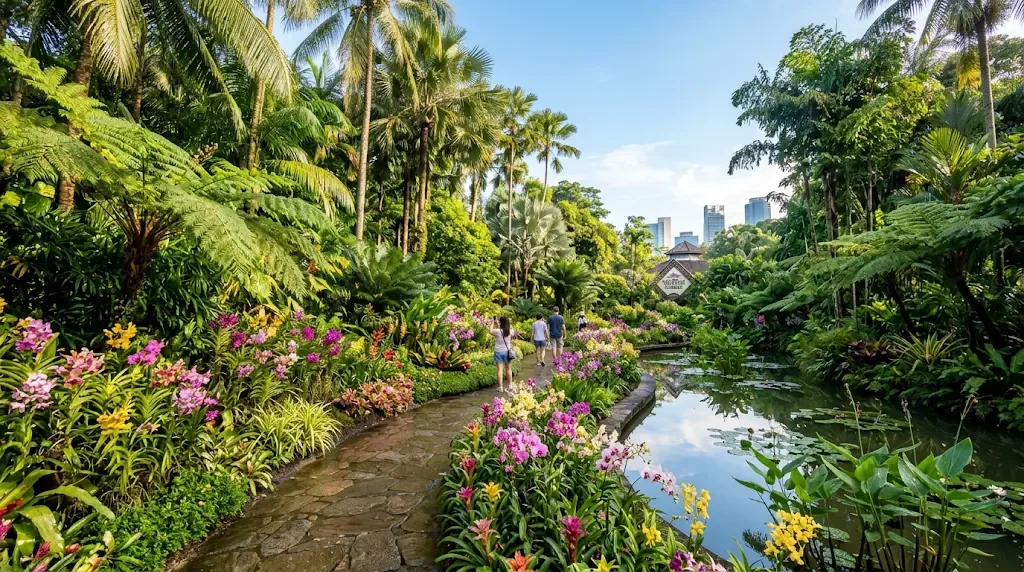
The rainy day counts look alarming, so a word on what they mean. Singapore rain usually arrives as a short, heavy downpour, often in the afternoon or early evening, and then stops. A day with a 30 minute storm counts as a rainy day here just like a washout would. In practice, even in the wetter months most days still have long dry stretches, and you can plan around them.
The Singapore Year, Monsoon by Monsoon
Singapore sits just north of the equator, and its seasons are defined by wind, not by temperature. There are two monsoons and two transition periods between them.
Northeast monsoon, wet phase: December to early January
This is the wettest stretch of the year. December averages 11.9 inches (302 mm) over 28 rainy days, and January still brings 8.7 inches (221 mm) over 22 days. Sun drops to 8.4 hours a day in December, tied with November for the lowest of the year, and humidity sits at 85%. Rain in this phase can set in for longer periods, sometimes a few days of on and off showers rather than one sharp storm.
That said, December is far from a lost month. The holiday lights along Orchard Road and the waterfront are a big draw, it is one of the two coolest months, if only by a hair (a high of 83.1°F, or 28.4°C), and Singapore's covered walkways, malls and underground links make it one of the easiest cities in the world to explore in rain. Just keep your expectations for beach time on Sentosa modest. The Singapore December weather page shows a typical month.
Northeast monsoon, dry phase: late January to February
This is the sweet spot. As the northeast monsoon matures, the air dries out and the rain eases sharply. February's 4.4 inches (112 mm) is roughly half of a typical month's total, and its 17 rainy days are the fewest of the year. Highs reach 84.2°F (29.0°C), lows sit at 76.5°F (24.7°C), and you get 10.2 hours of sun.
The one complication is Chinese New Year, which usually falls in late January or February. It is a great time to see Chinatown decorated, but some small family businesses and hawker stalls close for a few days, and hotels fill with regional visitors. If you want the weather without the holiday, aim for the second half of February in a year when the new year falls early. See Singapore in February.
First inter monsoon: March to May
Between monsoons the winds go light and variable, and the afternoons build into thunderstorms. Rain climbs fast: March gets 8.1 inches (206 mm), April 9.4 inches (239 mm) and May 9.3 inches (236 mm), with 24, 27 and 28 rainy days. These months are also the hottest, with a May high of 84.9°F (29.4°C) and a low of 79.0°F (26.1°C), and with little wind to take the edge off, they feel the stickiest.
The silver lining is that inter monsoon storms are usually short and fierce rather than long. Mornings are often clear and bright, with 10.4 hours of sun a day in March and April. If you are an early riser, do your outdoor sightseeing before lunch and you lose very little.
Southwest monsoon: June to September
For many travelers this is the best time to visit Singapore in practice: it is the second driest season, and the one most visitors from the northern hemisphere can actually fit around school holidays. Rain falls back to 6.3 inches (160 mm) in July, the second lowest total of the year, and 6.8 inches (173 mm) in September. Humidity drops to 81% in July. Early morning squall lines, bands of storms that sweep in before dawn, are typical of this monsoon, so a wet night can still lead to a fine day.
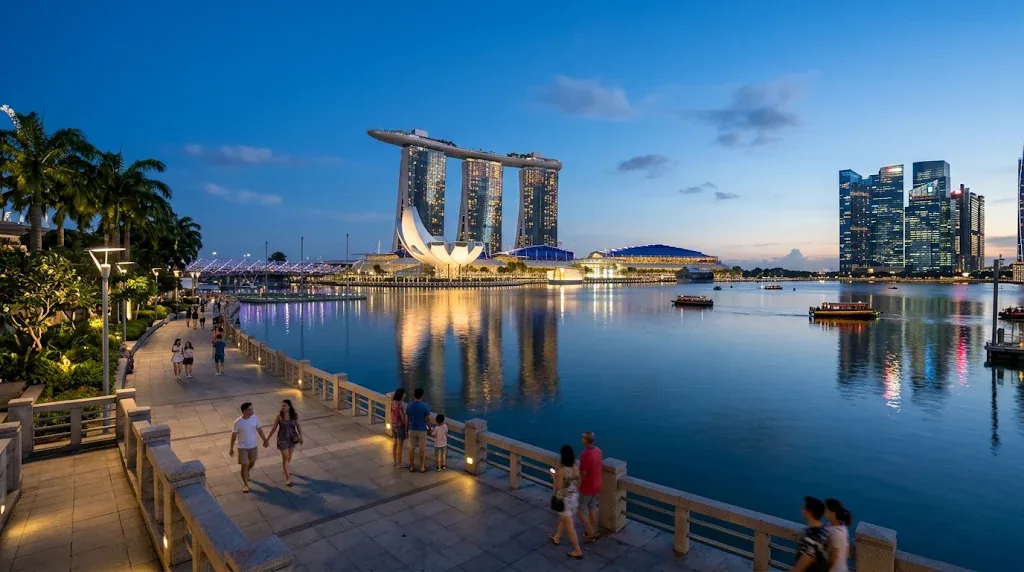
June is a little wetter than July, at 8.2 inches (208 mm), and August sits in between at 7.1 inches (180 mm). The National Day celebrations on August 9 bring parades and fireworks over the bay, and the Formula 1 night race usually takes over the Marina Bay area in September or October, so check those dates if you prefer quiet hotels. The Singapore July weather page is a good reference.
A hedge worth adding: in some years, smoke from land and forest fires elsewhere in the region drifts over Singapore as haze, most often between roughly June and October. It does not happen every year and its severity varies a lot, so check air quality reports close to your trip rather than planning around it months ahead.
Second inter monsoon: October to November
The thunderstorms return in October, at 8.5 inches (216 mm) over 26 days, and November is the single wettest month: 12.7 inches (323 mm), 28 rainy days, 85% humidity and 8.4 hours of sun. If you have a free choice, November is the month we would skip. Afternoon storms can be heavy enough to cause brief flash flooding in low spots and to disrupt outdoor plans. More on the Singapore November weather page.
So, the Best Time to Visit Singapore for You
- Least rain overall: February, then July and September.
- Sightseeing and walking tours: February or July. Book the open air spots, like the gardens and the waterfront promenades, for the mornings.
- Beaches on Sentosa or the outer islands: February to early March, or July. Avoid November and December.
- Festivals and city atmosphere: Chinese New Year in late January or February, National Day in August, holiday lights in December.
- Stopover on a longer trip: any month works. A two or three day stay is mostly indoors and covered walkways anyway.
- Combining with neighbors: February also suits much of mainland Southeast Asia. Our best time to visit Thailand and best time to visit Vietnam guides cover those countries, which have more pronounced dry seasons.
If Singapore is the warm leg of a winter escape, our roundups of where it is warm in December and best places to visit in February put it in context with other destinations.
All Twelve Months, Ranked
If you just want an order of preference, here is how we would rank the months, driest first. It is based on total rain, with rainy days and sunshine as tie breakers.
- February: 4.4 inches (112 mm), 17 rainy days. The clear winner.
- July: 6.3 inches (160 mm), 23 rainy days, 81% humidity.
- September: 6.8 inches (173 mm), 22 rainy days.
- August: 7.1 inches (180 mm), 25 rainy days, with National Day on the 9th.
- March: 8.1 inches (206 mm), but 10.4 hours of sun a day.
- June: 8.2 inches (208 mm), 25 rainy days.
- October: 8.5 inches (216 mm), storms returning.
- January: 8.7 inches (221 mm), drying out as the month goes on.
- May: 9.3 inches (236 mm), the hottest and stickiest month.
- April: 9.4 inches (239 mm), 27 rainy days.
- December: 11.9 inches (302 mm), saved by the holiday lights.
- November: 12.7 inches (323 mm), the one we would skip.
Notice how tight the middle of the list is. Six months on this list, from March down to April, all fall between 8.1 and 9.4 inches (206 and 239 mm), so if your dates are fixed by flights or school calendars, do not stress over choosing between, say, June and October. The real gap is at the two ends: February is clearly better than everything else, and November and December are clearly worse. That is the simplest way to think about the best time to visit Singapore.
Living with the Heat and Humidity
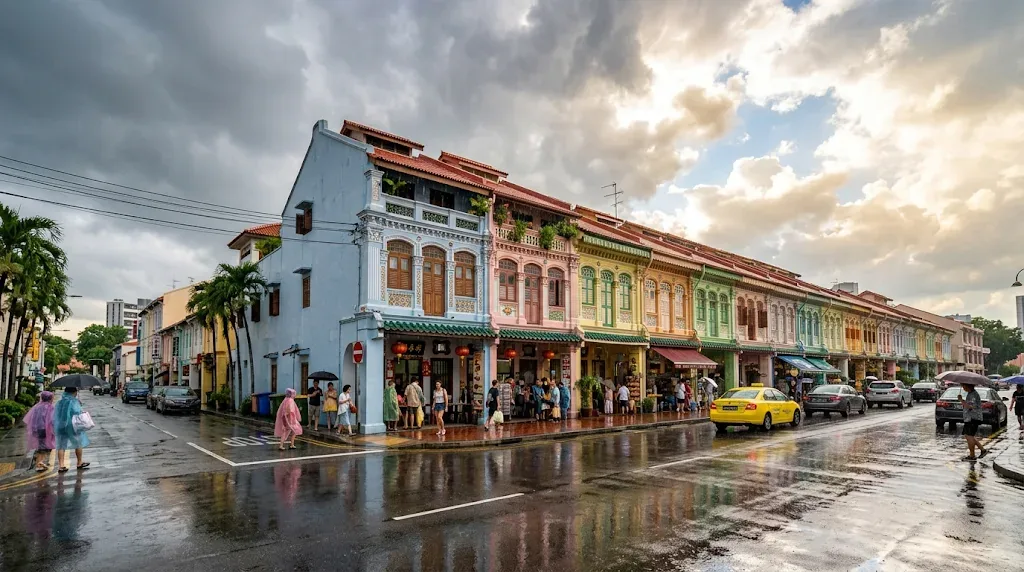
Here is the thing that surprises first time visitors more than the rain: the humidity never lets up. It ranges from 81% to 85% across the year, and with lows of 76.1°F to 79.0°F (24.5°C to 26.1°C), nights offer little relief. You will sweat walking ten minutes to a train station. That is just Singapore.
A few habits help. Plan outdoor sights for the first few hours after sunrise and again after about 6pm, when the light softens and hawker centers fill up. Use the middle of the day for museums, malls and long lunches. Carry water, because dehydration sneaks up fast at these temperatures. And note that indoor air conditioning is set very cold, so the jump from 84°F (29°C) outside to a chilly mall can be sharp.
What to Pack for Singapore
- Light, breathable clothes in cotton or linen, and more changes than you think you need.
- A compact umbrella. It doubles as sun shade, and locals use it for both.
- Sandals or quick drying shoes for downpours, plus one pair of closed shoes for nicer restaurants.
- A thin layer such as a cardigan for cinemas, buses and air conditioned malls.
- Sunscreen and a hat. Even in the cloudiest month you still average 8.4 hours of sun.
Our guide to dressing for 80 degree weather covers fabric choices that work well here.
About These Numbers
The figures in this guide are WeatherApex 20-year averages (2006 to 2025) for Singapore, built from the Open-Meteo historical weather archive. They describe a typical month, not a forecast. Monsoon timing shifts a little from year to year, El Nino and La Nina years can be noticeably drier or wetter, and a single big storm can double a week's rain. Use the averages to choose the best time to visit Singapore, then check the local forecast a few days before you fly. You can see more on the Singapore weather overview, or compare it with other stops in our trip planner.
One planning tip to finish: whatever month you pick, keep one afternoon of each day loosely scheduled. In Singapore the storm usually comes, passes and leaves everything washed and a little cooler, and the hour after it clears is often the nicest of the day.
Frequently asked questions
What is the best month to visit Singapore?
February. It averages 4.4 inches (112 mm) of rain over 17 rainy days, the lowest of the year on both counts, with 10.2 hours of sun and 81% humidity. July is the next driest at 6.3 inches (160 mm).
What is the rainy season in Singapore?
The wettest period is November to January, at the end of the second inter monsoon and the start of the northeast monsoon. November averages 12.7 inches (323 mm) over 28 rainy days and December 11.9 inches (302 mm). Storms are also frequent from March to May.
Is Singapore hot all year?
Yes. The average high only moves from 82.9°F (28.3°C) in January to 84.9°F (29.4°C) in May, and lows stay between 76.1°F and 79.0°F (24.5°C and 26.1°C). Humidity runs from 81% to 85% in every month.
Is it worth visiting Singapore in December?
Yes, for the holiday lights and a city built for rain, but expect wet weather. December averages 11.9 inches (302 mm) over 28 rainy days with 8.4 hours of sun. Most storms pass in an hour or two, so plan indoor sights for the afternoons.