Best Time to Visit Vietnam: Why North and South Need Different Months
There is no single best time to visit Vietnam: Hanoi is best in November (8 rainy days, 77.7°F) while Ho Chi Minh City is best in February (3 rainy days, 11.2 hours of sun). December is the closest compromise.
The best time to visit Vietnam depends on which end of the country you start in. For Hanoi and the north, October and November are the sweet spot, at 77.7°F to 83.1°F (25.4°C to 28.4°C) with 8 to 13 rainy days. For Ho Chi Minh City and the south, December to February is better, with only 3 to 9 rainy days a month. If you want one compromise month, December is the closest we can find.
Vietnam is a long, thin country with three climates that rarely behave alike, so a single "best month" sounds neat and is wrong. Below we use WeatherApex's 20-year averages (2006 to 2025) for Hanoi and Ho Chi Minh City to show the north and the south, then say plainly what we cannot measure in between.
Best time to visit Vietnam: the quick answer
These six rows are the months we would actually pick, three for each city. They cover only the two cities in our data: Hanoi in the north and Ho Chi Minh City in the south.
| City and month | Avg high | Avg low | Rainy days | Sunshine | Humidity |
|---|---|---|---|---|---|
| Hanoi, November | 77.7°F (25.4°C) | 65.3°F (18.5°C) | 8 | 7.1 h | 76% |
| Hanoi, October | 83.1°F (28.4°C) | 71.4°F (21.9°C) | 13 | 8 h | 79% |
| Hanoi, April | 84°F (28.9°C) | 70.9°F (21.6°C) | 11 | 6.5 h | 81% |
| Ho Chi Minh City, February | 91.8°F (33.2°C) | 73.6°F (23.1°C) | 3 | 11.2 h | 66% |
| Ho Chi Minh City, January | 88.7°F (31.5°C) | 72.7°F (22.6°C) | 4 | 10.3 h | 70% |
| Ho Chi Minh City, December | 87.6°F (30.9°C) | 73.2°F (22.9°C) | 9 | 9.7 h | 75% |
Best Time to Visit Vietnam: The Quick Answer
Anyone searching for the best time to visit Vietnam as a whole country will be disappointed by the data. Look at the two cities side by side and the problem is obvious. Hanoi has a real winter: January averages 67.8°F (19.9°C) for the high and 56.1°F (13.4°C) for the low, about 20°F cooler than Ho Chi Minh City's 88.7°F (31.5°C) high in the same month. Hanoi also has a proper hot, wet summer, peaking in August with 23 rainy days and 13.8 inches (351 mm) of rain.
Ho Chi Minh City barely has seasons in temperature at all. Its average high stays between 86.7°F and 93.9°F all year. What changes is the rain: from just 3 rainy days in February to 29 in July, August and September. So the south runs on a dry-versus-wet calendar, while the north has all four seasons, and their best months only overlap in a narrow window.
That is why a month that is perfect in one place can be a poor choice in another. February is the driest month in Ho Chi Minh City (0.6 inches, 15 mm) and one of the greyest in Hanoi, where it gets only 4 hours of sun a day. September is wet nearly everywhere.
Hanoi and the north, season by season
October to early December: our favorite
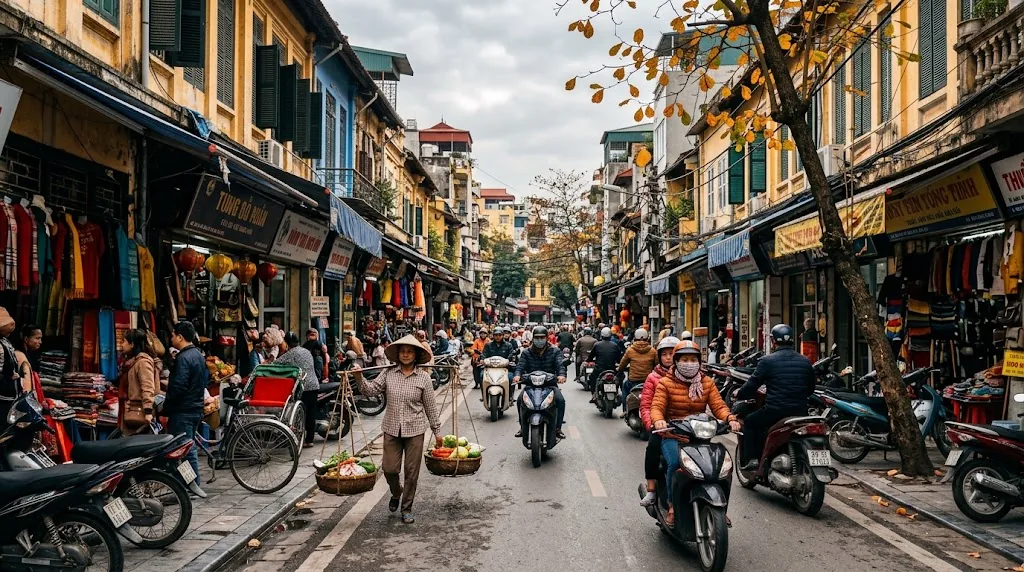
This is when northern Vietnam is at its best. By November the rain is down to 2.3 inches (58 mm) over 8 days, humidity is a manageable 76%, and highs sit at 77.7°F (25.4°C) with cooler evenings near 65°F (18.5°C). You can walk the Old Quarter all day without sweating through your shirt, and sunshine returns to a healthy 7.1 hours.
October is a little warmer and wetter (83.1°F, 13 rainy days, 6.5 inches), and rain tends to ease through the month. December is cooler again at 70.2°F (21.2°C), with just 7 rainy days and 1.3 inches. The Hanoi November page has the full set of figures.
January to March: cool, grey and damp
Do not expect blue sky in a Hanoi winter. Sunshine averages only 4.2 hours a day in January, 4 in February and 4.1 in March, the lowest figures on our entire chart. It is not very cold (highs of 67.8°F to 77.4°F), but the low cloud and drizzle can make 60°F feel colder than it reads. If you plan a trip in this window, treat Hanoi as a city for food, cafes and museums rather than for photos of landscapes.
The northern mountains and Ha Long Bay can feel particularly cool and misty in winter, which is a matter of general experience rather than something in our data. Pack a proper layer.
April: pleasant, then it turns
April is the shoulder month. The average high is 84°F (28.9°C), sunshine jumps to 6.5 hours and humidity is 81%. Rain starts to build with 11 rainy days and 3.9 inches. It is a decent time for Hanoi, but May is where it changes: the high hits 88.3°F (31.3°C) and rain more than doubles to 8.9 inches (226 mm) across 17 days.
May to September: hot, wet and sticky
June is the hottest month in Hanoi at 91.4°F (33°C), and July and August bring 21 and 23 rainy days with humidity of 82% to 86%. The rain often comes in heavy bursts, so mornings can be sunny. We would skip the north in July and August unless a festival or flights drive your dates. See Hanoi in April for the shoulder-season detail.
Ho Chi Minh City and the south
The south has two seasons. The dry season runs from about December to April, and the wet season from May to November.
- December to February: the best stretch. Rainy days drop to 9, 4 and 3, humidity falls to 75%, 70% and 66%, and sunshine runs between 9.7 and 11.2 hours. Highs are 87.6°F, 88.7°F and 91.8°F (30.9°C, 31.5°C and 33.2°C), which is hot, but with less sticky air than the rest of the year.
- March and April: the hottest part of the year. March has an average high of 93.9°F (34.4°C) and April 93.4°F (34.1°C). Rain is still low in March (6 rainy days) but April climbs to 13. Visit if you like heat, and plan sightseeing early and late.
- May to October: the wet season, with 26 to 29 rainy days a month. That sounds grim, but sunshine still averages 8.1 to 9.9 hours a day, because the rain tends to come as short, heavy bursts rather than all-day drizzle. September is the wettest, with 13.3 inches (338 mm).
- November: a transition month with 18 rainy days and 5.8 inches, easing off into December.
For a southern trip, February is our top pick: Ho Chi Minh City in February has 3 rainy days, 11.2 hours of sun and the lowest humidity of the year. We would avoid September and October unless you are happy to carry a rain poncho.
The middle of the country: what we can and cannot tell you
Hue, Da Nang and Hoi An sit between our two cities and are not in our dataset, so we have no numbers for them. Generally speaking, the central coast has its own pattern: it tends to be driest and best for the beach in roughly the spring and early summer, and wettest in autumn, when heavy rain and flooding are most likely, often from around October into November. That is the reverse of Hanoi, where autumn is the best season.
If you are building a route from north to south, this is the awkward part. A November trip might give you ideal Hanoi weather and a wet Hoi An. Check local forecasts for the central coast close to your dates, and keep some flexibility in the itinerary.
If you can only pick one month
Some people have fixed dates and want a single answer anyway, so here is ours for the best time to visit Vietnam when you are covering both ends.
December is our compromise. Hanoi has 7 rainy days and 1.3 inches of rain, while Ho Chi Minh City has 9 rainy days and 2.3 inches. January and February have even fewer rainy days across the pair (12 and 11 combined, against 16 in December), but Hanoi is at its greyest then, with 4 to 4.2 hours of sun a day. In December Hanoi recovers to 5.5 hours, and Ho Chi Minh City is still comfortably dry. November is the other contender, but its southern half is still wet, with 18 rainy days.
The honest drawbacks of December: Hanoi is cool, with lows around 57.9°F (14.4°C) and 5.5 hours of sun, so it is not a beach-and-sunshine month in the north. The central coast is also likely to see some rain in early winter. If you want fewer trade-offs, split the trip by region rather than trying to find one date.
A few ways to build the trip by month
- Late October to November: start in Hanoi, add the north, and fly south at the end. Expect Ho Chi Minh City to be on the wet side in early November (18 rainy days).
- December to January: a good time for the whole country if you accept a cool, grey Hanoi. Ho Chi Minh City is at its comfortable best.
- February to March: favor the south and the beaches, and treat Hanoi as a short stop for food. The Lunar New Year (Tet) usually falls in late January or February and shuts many businesses for several days, so check the date for your year.
- April: reasonable for both cities, though the south is very hot (93.4°F) and the north is starting to get humid.
- May to September: not our first choice anywhere in our data. If you must go, expect heat and daily rain, and keep days flexible.
Typhoon season and what it means for your plans
Typhoons form over the western Pacific and the South China Sea, and the season usually runs from around June to November, with a peak in autumn. Storms most often hit the northern and central coasts, which is why autumn rain in Hanoi can be heavy and why central Vietnam has its worst flooding around October and November. Ho Chi Minh City sits further south and tends to avoid direct hits, although the wet season brings heavy downpours.
We do not have typhoon tracks in our data, so treat this as general background. Practical advice: if you book in late summer or autumn, choose flexible fares, avoid tight domestic flight connections on the central coast and check forecasts a few days before moving between regions. Our guide to the best time to visit the Philippines covers the same typhoon belt from the other side of the sea.
What to pack
For Hanoi between November and March, pack layers: long pants, a sweater and a light waterproof jacket, since it can be cool and damp at 56°F to 65°F at night. For Ho Chi Minh City, lightweight breathable clothes, a hat, strong sunscreen and a compact umbrella or poncho are enough in any month. Sandals that can get wet help in the wet season, and good walking shoes are a must for ruins and old towns. If you are thinking about adding a Thailand leg, our Thailand timing guide is a useful companion.
How we picked these months
All the numbers on the best time to visit Vietnam come from WeatherApex 20-year averages (2006 to 2025) for Hanoi and Ho Chi Minh City, with temperatures converted to Celsius and rain to millimeters. They cover those two cities only, so central Vietnam, the highlands and the islands are described in general terms without figures. Averages show what is typical, not what will happen on your dates. When you have a rough month in mind, compare it with the Hanoi weather overview and the Ho Chi Minh City December page, then use the trip planner for a forecast closer to departure.
Frequently asked questions
What is the best month to visit Vietnam?
No single month suits the whole country. November is best for Hanoi, with a 77.7°F (25.4°C) high and 8 rainy days, and February is best for Ho Chi Minh City, with 3 rainy days and 11.2 hours of sun. If you want one month for both, December is the closest, with 7 rainy days in Hanoi and 9 in Ho Chi Minh City.
When is the rainy season in Vietnam?
In Ho Chi Minh City the wet season runs from about May to November, with 26 to 29 rainy days a month from May to October and 13.3 inches (338 mm) of rain in September. In Hanoi the wet months are May to September, peaking in August with 23 rainy days and 13.8 inches (351 mm). The central coast usually gets its heaviest rain in autumn.
Is Hanoi cold in winter?
It is cool and grey rather than cold. January highs average 67.8°F (19.9°C) with lows of 56.1°F (13.4°C), and sunshine drops to only 4.2 hours a day. A sweater and a light waterproof jacket are enough for most visitors.
What is the hottest month in Vietnam?
In Ho Chi Minh City, March is the hottest at an average high of 93.9°F (34.4°C), followed by April at 93.4°F. In Hanoi, June is the hottest at 91.4°F (33°C), but with 18 rainy days and humidity around 80%.